
Not a German Drinking Song
The Origin Story of Ein Keloheinu


All of our synagogue tunes are just old German beer songs, right?
Many times have I fielded this quarrelsome query. Often it comes from those winking at the perceived promiscuity of Jewish music as it swings between sacred and secular realms, claiming it to be the true inheritance of the id and its impish desires.
Such parties are wont to rationalize their own penchants for liturgical parody, like the regular abuse of adon olam with transgressive pop tunes. I’m a pretty relaxed chap, but I’ll own that, due to words having meaning, this sort of thing really grinds my gears.
Yet such an experience is not limited to adon olam; almost any melody can be liquidated of pious direction and propositional content. After all, the word itself is only 7% of communication — the other 93% is conveyed by the body language and tone of the prayer leader.
I learned how to approach this issue from my teacher, Rabbi Marcia Prager. Leading a seminar of outside-the-box prayer practitioners, she asked us to consider our musical choices: do they lead to catharsis? Or to deepening?
The former is the release of energy, like the applause or cheers after an amazing performance. The journey is purgative. But in Jewish liturgy, there is no clapping (except perhaps for the Lord) and a more ambitious goal than emotional refreshment. The direction of musical energy must therefore be brought beyond externalized catharsis to the more humble, interior space of divine communion. Often this means bringing the energy of sacred music down, especially as it concludes. The higher the musical intensity, the more focus it takes to direct one’s intentions towards God. The feeling of “Whee!” is easy to sell, but not half as valuable as the religious feeling of “Whoa.”
As proof of their theory, the aforementioned beer brokers proffer the example of that most Teutonic of synagogue tunes: Ein Keloheinu.
Yet today it is my pleasure to confirm that this melody did not come from a beer hall.
It comes from Braunschweig.
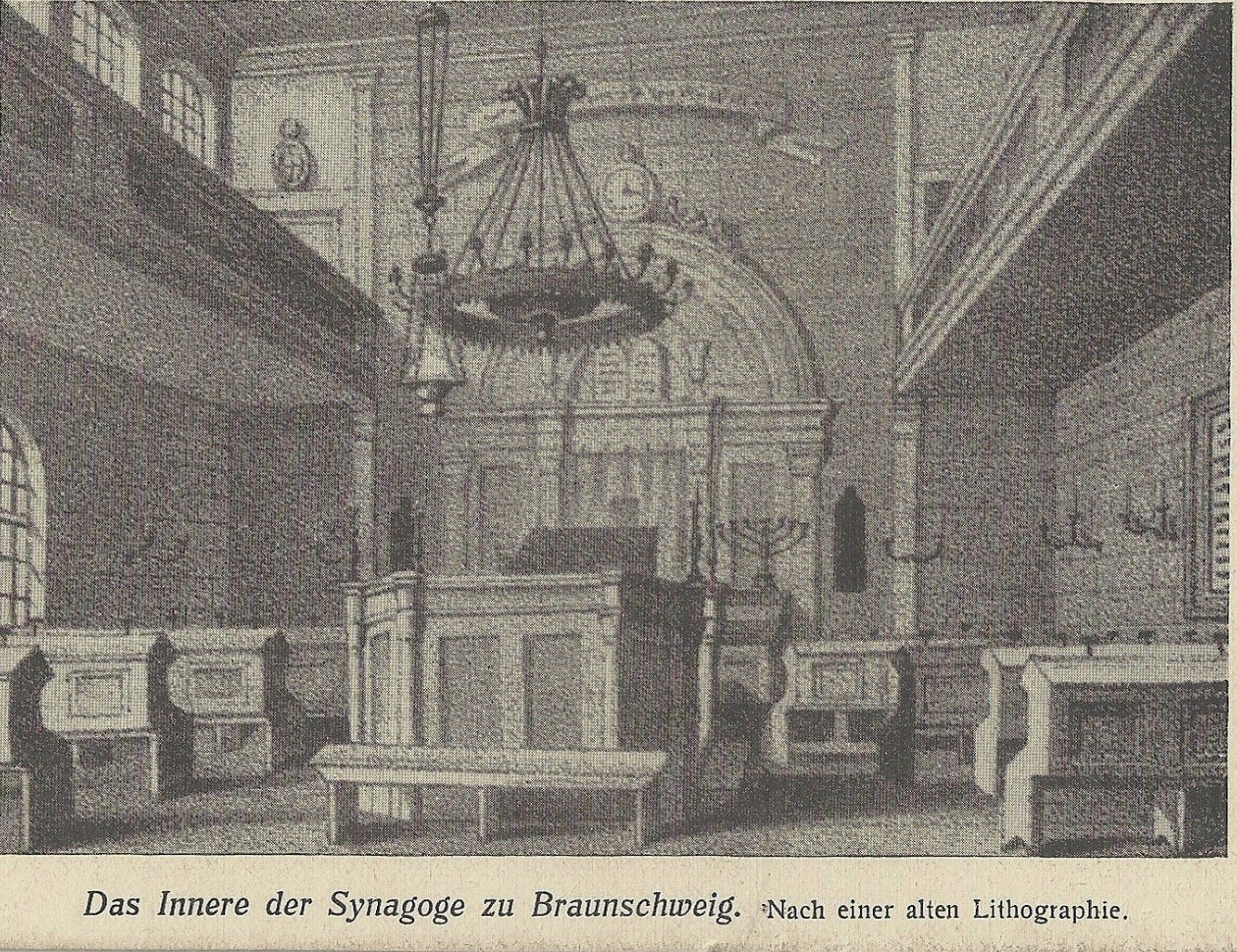
Given full civil rights by the Napoleonic Empire in 1808, the Jews of Braunschweig were among the first to absorb the aesthetic program of the Jewish Enlightenment. While not formally Reform, the community’s rabbis quickly began to preach in German and were influenced by Haskalah ideals. By 1841, both of the synagogue’s clergy — Rabbi Levi Herzfeld and Cantor Hirsch Goldberg — were modernizing forces committed to the the revival of Jewish culture and the introduction of choral singing. One year later, they introduced a new program of sacred choral music with the help of their music director, Julius Freudenthal.1
Freudenthal (b. 1805) was a Braunschweig native and a talented violinist who had been appointed Music Director of the Duchy Court in 1841 — one of the first Jews to rise to such a high musical office.2 While active in secular music and German politics, Freudenthal was well-positioned to partner with Herzfeld and Goldberg to create a new synagogue aesthetic for Braunschweig.
Writing in the Jewish Press about this new style, one community member gushed:
“Whereas previously it was only with difficulty to gather the meager number of people for the minyan at prayer time, now a fresh, youthful energy has emerged. Many men, women, and girls—previously completely estranged from the synagogue except on Rosh Hashahnah, Yom Kippur and “Sermon Shabbat”— now meet there almost every Friday evening and Shabbat morning.
With joyful zeal, under the direction of the music director of the Duke’s Chapel, Mr. Freudenthal (an Israelite and member of the congregation), and our excellent cantor, Mr. Goldberg, the choirs and singers have practiced the hymns which resound in our temple in praise of the Most High. All responsorials between the congregation and the cantor are arranged in such a way that both parts join in at the proper time, without that dissonant shouting being heard anymore.”3
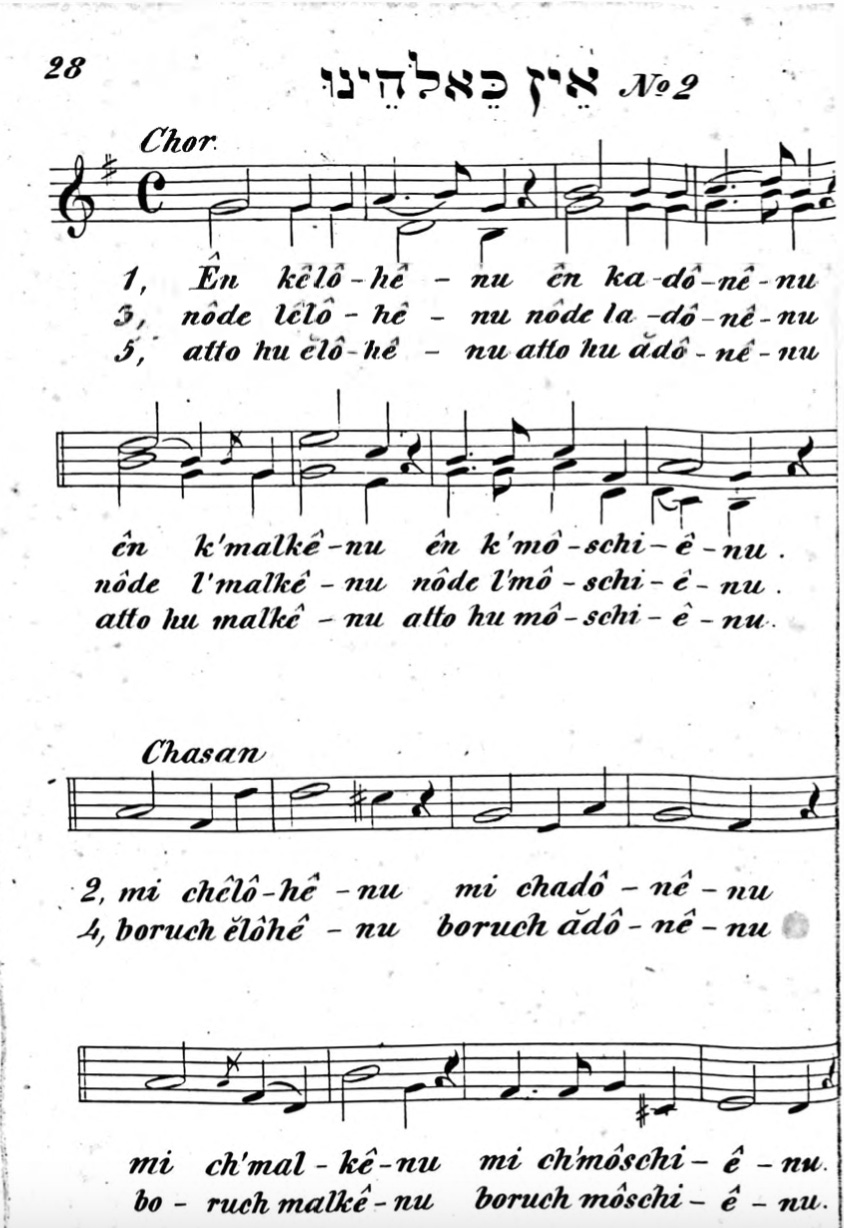
We often imagine choral music as an elite enterprise, but back in 1840, it was seen as an popular spiritual engagement tool reviving a flagging service. In the introduction to his published songbook, Gesänge der Synagoge zu Braunschweig (1843), Goldberg describes the situation of his small community trying to adapt to this new wave of choral innovation, known mostly from more established modern communities like those in Seesen, Hamburg, and Vienna. His own publication presented excerpts of these early choral reforms, together with his community’s own traditional melodies and new compositions. Goldberg writes of an expansive musical vision of the choir— one which fully encompass the congregation:
“A simplified reworking of Sulzer’s polyphonic hymns seemed absolutely necessary to us, given the impossibility of adequately filling every part in a relatively small congregation; our own compositions are often based on the traditional synagogue melodies. That I have now submitted these hymns to print was done both to make them more readily available to all members of the congregation and in the hope that other congregations might also have them reviewed and, if suitable, adopt them.
The term “choir” was chosen because not all members of our congregation can yet sing the introduced melodies, and this will undoubtedly be the case in every congregation for some time, during which period a choir must represent them. This choir, however, will continually grow and eventually encompass the entire congregation.”4
Goldberg’s strategies are still recognizable today. Whether for sophisticated choral music or contemporary nigun/song circles, the gap between professional musicians and lay worshipers remains wide. Goldberg’s little community cannot simply execute the great Sulzerian repertoire of urban Vienna — it must be adapted for his more modest milieu.5 Goldberg & Freudenthal’s simpler, two-part harmonies also invite a future in which the congregation, over time, will become the choir itself. This same instinct drove future hymnals of Jewish synagogue music, including Anglo-Jewry’s “blue book” The Voice of Prayer and Praise (1899) and Mathilde Schechter’s Hebrew Hymnal for School and Home (1910). In this way, the printing of Jewish choral music served to enliven and democratize prayer and ensure congregational participation amongst a Jewish laity steeped in music literacy.
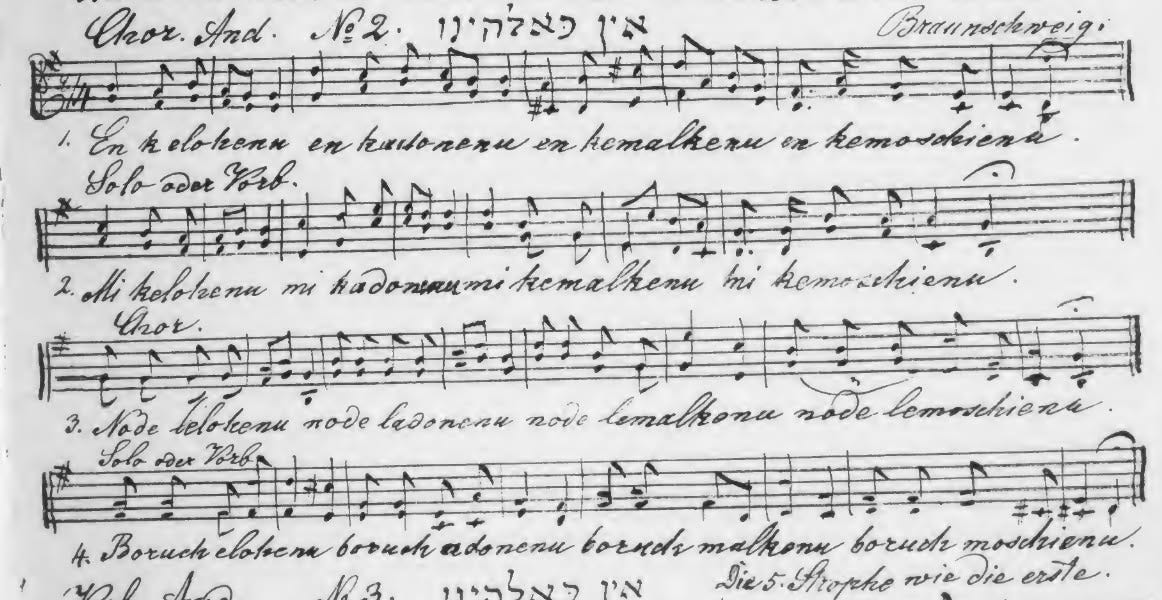
Freudenthal’s En Keloheinu was an instant hit. Adaptations of the melody are discernible in Seesen in 1866, by Lewandowski himself in 1871, and across American Jewish hymnals.6 But the viral success of this piece is most evident from the above Ein Keloheinu, published by Herman Ehrlich in the small town of Meiningen as part of the first ever cantorial journal.
The composer’s name is not mentioned; only the piece’s association with Braunschweig. Goldberg & Freudenthal added composer attributions only in the third edition of Gesänge in 1853, accounting for this omission. But the most striking thing is that the melody has already taken on a mind of its own, expanded into four (not two) sections at complete variance from the original, published melody. Within five years, it appears that the people have already paid Freudenthal their highest compliment by adopting (or “varbessering”) his precious melody.
No beer song, our most famous Ein Keloheinu melody was written by a high-ranking Jewish music director as a fit-to-purpose Hebrew hymn meant for congregational engagement.
As much as Oktoberfest, his tune has stood the test of time. To Herr Freudenthal, we should surely lift our beer steins and say: “Ein Prosit der Gemütlichkeit” — a toast to good cheer and belonging.
This background and the impetus for this article was inspired by the study of the musical. tradition of Braunschweig conducted by Cantor Amnon Seelig in his masters thesis, “Hirsch Goldberg’s Compositions and the Music of the Braunschweig (Brunswick) Jewish Community in the 19th Century,” University of Potsdam, 2008.
For a short biography of Freudenthal in German, see https://www.deutsche-biographie.de/sfz17099.html?language=en#adbcontent. During research for this article, I made the unexpected discovery of one of Freudenthal’s original manuscripts for his opera parody, Die Barden (“The Bards”), gifted to the “Gesängverein Boston” (Boston [German] Choral Society) in 1861: https://archive.org/details/DieBarden/page/n3/mode/2up.
Allgemeine Zgeitung des Judentums 46 (November 12, 1842): 679-680.
Gesänge der Synagoge zur Braunschweig, ed. Hirsch Goldberg (Braunschweig, 1843): iii-iv.
The opposite of this phenomenon — in which small Jewish communities uncritically attempt to recreate the musical successes and forms of large urban synagogues — is also familiar today. It was described to me by my teacher, Rabbi Marcia Prager, as a form of “cargo cult.” Historically, the cargo cult was an effect in which native peoples would begin to worship the cargo and goods brought by colonial powers. In both scenarios, the imported novelty retains a magical and almost messianic appeal, despite being foreign to the population, purposes, and capabilities of the local community.
For a full analysis of the melody, see Seelig, “Hirsch Goldberg’s Compositions," 36ff. Notably, Seelig rejects Idelsohn’s assumption that the Freudenthal melody is indebted to the German hymn, Großer Gott, wir loben dich.
I’m delighted you are helping set the record straight about this tune! Great article.
Really interesting, Matt. I often wonder how you track these things down, but thanks so much for doing it -- it truly serves the community. And thanks for tipping the hat to our amazing teacher and beloved maestra of davvening, Reb Marcia.