
Seeing the Forest
A Shema-Themed Faith Journey


The traditional Ashkenazi service is often recited often at great speed. While there is great truth to this shamanic form of prayerful incantation, it can leave one with less time to dwell on the profound meanings of these centuries-distilled religious poems.
When I teach cantors and prayer leaders, I often compare davening to the art of throwing pizza dough: Sometimes you’re just moving text — with prayerful intention but not with a meditative focus on each and every word. Then you reach a moment of musical expression, the equivalent of throwing the pizza dough up in the air.
You are alert. You feel the excitement. You you hear the prayer cascade in beauty and intention…and then you catch the dough, and you’re moving it again — with feeling, of course.
These moments of uplift are the heart of chazonus, the cantor’s art, which I like to describe as musical faith-sharing in real time. I love worship which doubles down on highlighting these moments of kavanah (intention) through music. Such services usually last a little longer, but like any great experience, you don’t care because you’re into it.
In the coming weeks, I hope to toss some more liturgical dough in the air with a few essays on the interior space of individual Jewish prayers. But before delighting in such trees, let’s take a look at the forest — this time of the Shema and her blessings.

The daily Jewish liturgy surrounds its statement of creed, the shema, with three (and in the evening, four) blessings.1 I have long thought that the themes set down by the rabbis for these blessings comprise a deep spiritual journey into faith – from the most accessible to the most challenging and rewarding. They are:
Birkat Yotzer: Finding God in Nature
Birkat Ahavah: Finding God in Torah/Wisdom
Birkat Geulah: Finding God in History
The ascending depth of this progression immediately becomes apparent. Finding God in nature is universal. It is the essential posture of wonder which is the ground of almost all religion. I remember being on Santa Cruz island in the middle of the Pacific as a young yeshiva student and being shocked by natural beauty into this very feeling – one of being infinitely small and yet part of something much greater. This is what Rudolf Otto described as “the numinous” in his theory of holiness. It is also not so different from the “whoa” one experiences in music — it is elemental and elementary spirituality.
The second blessing in this progression – ahavah (Love)– is about finding God in Wisdom. In Judaism, the gift of revelation is seen as primarily an act of divine love. Just as a parent loves their child and gives them wisdom and instruction for living a good life, HaShem gives wisdom as an act of love, binding His destiny to ours.
Note: this is not as easy as the natural enchantment of nature. It demands study and action, to meditate on the Torah’s words and “recite them when you stay at home and when you are away, when you lie down and when you get up (Deut. 6:5).” It also requires one not only to receive wonder, but to live out and transmit wisdom to the next generation.
The final blessing in this series — ge’ulah — is neither about glorious nature nor wise words, but about finding God in the past and the present. That is why the mi chamocha, from the Song at the Sea (Ex. 15) and God’s most iconic redemption of our people, is its anchoring image. Affirming God’s redemption in one’s life is perhaps the hardest blessing of all, but the most rewarding. As Viktor Frankl, the famous psychologist taught: “Life is not primarily a quest for pleasure, as Freud believed, or a quest for power, as Alfred Adler taught, but a quest for meaning.” That is why this third blessing holds the deepest form of faith.
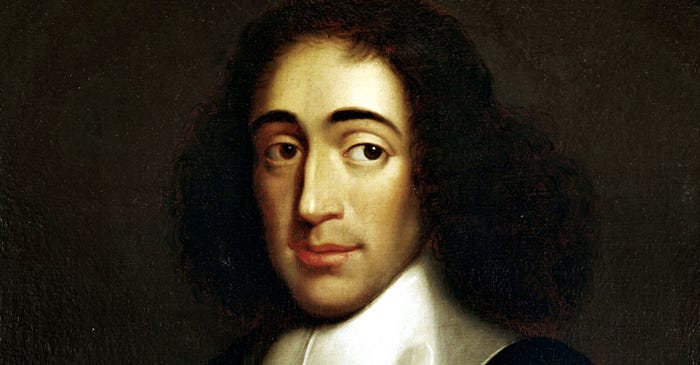
This three-part faith is paralleled, perhaps surprisingly, in Baruch Spinoza’s Ethics (I.15). Based in the idea that everything must be conceived through God, Spinoza describes the three ways of knowing about the world: imaginatio (imagination), ratio (reason), and scientia intuitiva, or “intuition.” The first comprises human sense perception, the second rational knowledge, and the third a theological alignment, or as Orit Arfa aptly describes it, “a holistic understanding of the universe, human nature, and, most of all, ourselves and our capabilities.”
This question of Spinozan intuition and faith was not unlike the biblical dilemma of the spies (cf. Num. 13:32). It is easy to say: “The history that we traversed and scouted is one that devours its inhabitants.” But Judaism’s faith challenges us to intuit the divine perspective, and instead say: כי יכול נוכל לה – “we can surely overcome them.”2
Yet even this deep faith is bracketed. In the evening, Jews add a fourth prayer to this series — hashkiveinu — which asks God for his protection during the night. The rabbis recognized sleep as “one sixtieth of death3,” in which our souls were held in God’s care and returned again upon awakening. Even with faith, God’s ways are not our ways, and so we ask for the safety and security we need to be vulnerable in sleep.

This forest of blessings around the shema are not a catechism. They are an invitation — the sites of both spiritual improvisation across centuries of liturgical poetry and of reckoning with life’s difficulties, ruptures, and challenges.
The trajectory itself shows us our opportunities to grow, from seed to plant, towards our source of light.
Cf. Mishnah Brachot 1:4.


BT Berachot 57a.
Yasher koach.