
Rossi the "Great"
The Creation of a Hero

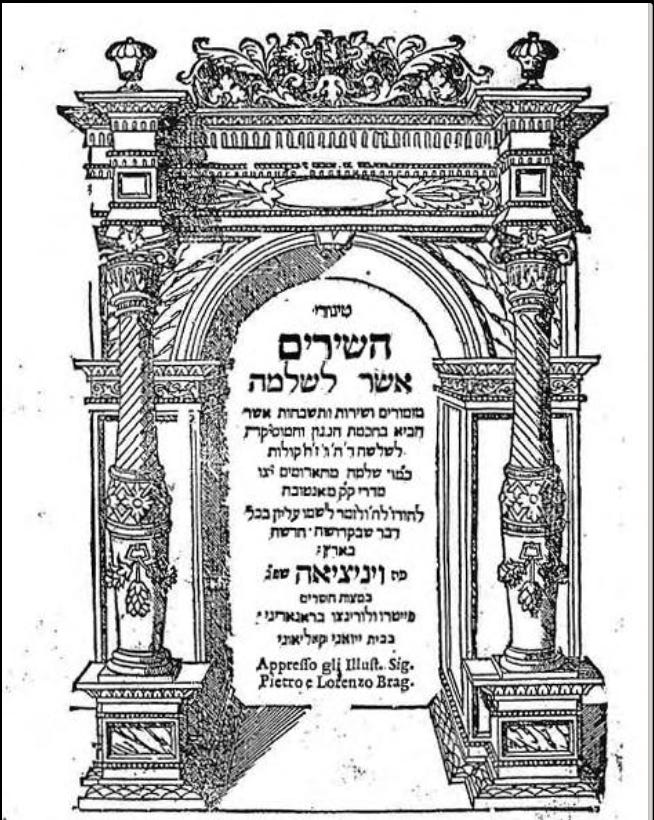
The Italian-Jewish composer Salamone Rossi (1570-1630) is widely regarded today as the grandfather of Jewish choral music. As a contemporary of Claudio Monteverdi at the Gonzaga court in Renaissance Mantua, Rossi was a prolific and successful artist with over three hundred compositions to his name. But one volume alone secured for him an honored place in the annals of Jewish music history. That volume was HaShirim Asher Lishlomo (“The Songs of Solomon”, 1623), the first complete book of Jewish liturgical compositions in Western polyphony.
This “revolution” in sacred sound inspired both critics and defenders, but ultimately did not lead to seismic changes in synagogue aesthetics. Rossi’s Hebrew madrigals were more of a Jewish choral “flash-in-the-pan.” He had no successors, and his compositions lay largely dormant until the mid-nineteenth century.
Yet today, Salamone Rossi stands in the contemporary pantheon of “Great Jewish Composers” alongside famous figures like Salomon Sulzer and Leonard Bernstein. His Hebrew madrigals are similarly celebrated and programmed by choirs and early music ensembles all over the world.
How is it that this little-known Jewish composer came to signify so much?
Today I’ll take up this question, with much debt to recent research by my doctoral advisor, Edwin Seroussi. For myself, I will offer new reflections plus share a little-known story of how the “Rossi revival” was fired by America’s newly-founded cantorial schools and by the pioneer ensemble of the Early Music movement.
In the two centuries following their publication, partbooks of Rossi’s Hashirim Asher Lishlomo circulated throughout Europe with little effect. Only in the case of early modern Bohemia, where Ashkenazi musicality reached a unique zenith, does historical evidence suggest that the madrigals were lifted off the page. At least one copy (Bodleian Library, Opp. 4o 1119) reached several seventeenth-century Jewish owners (including one cantor) who took the time to learn Western notation and use the melodies in synagogue. These Ashkenazi readers likely possessed only one partbook, unable to appreciate the polyphonic glory of Rossi’s full compositions. But they did see that these notated Hebrew melodies were of religious significance. Rabbi Shlomo Lifschitz (1678-1750) also likely came in contact with this very copy, and from it concluded that all cantors should embrace aspects of Western musical technique in worship: “for song without the science of music is like prayer without intention.”1
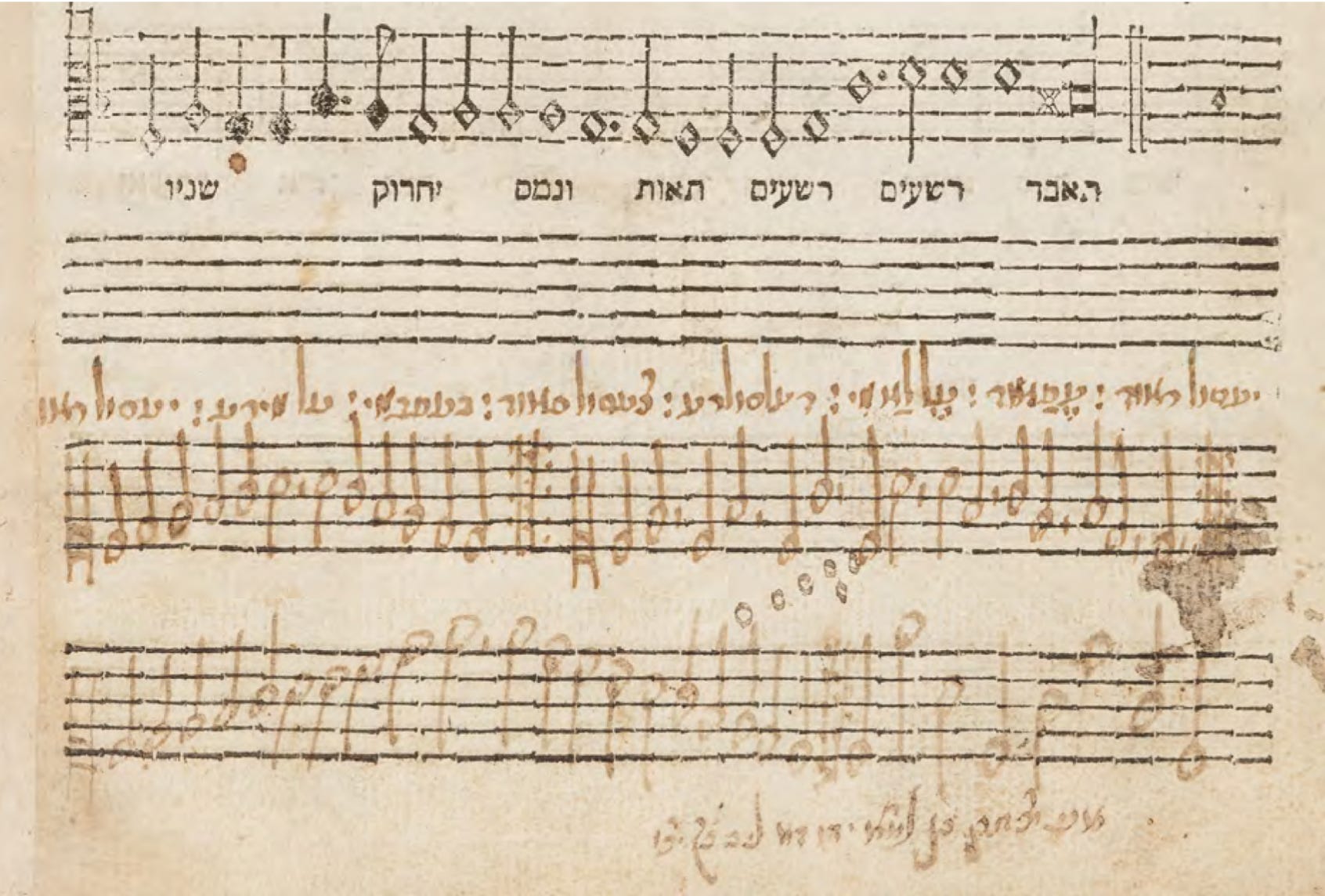
Until the nineteenth century, Hashirim Asher Lishlomo operated in this register as a Hebrew musical artifact, representing the legitimacy of Western notation as a religious good to at least one generation of Bohemian Ashkenazi cantors. Otherwise, it remained, at best, a historical footnote.2 This would change with the work’s rediscovery in the nineteenth century and its republication in 1877 by Cantor Samuel Naumbourg.Here, Rossi began his journey of elevation from Hebrew artifact to national artistic symbol, embodying Jewish creativity for the Westernizing cantorate of Europe.
As Edwin Seroussi observed, the Parisian Naumbourg idolized Salamone Rossi as a “genius” within the Romantic conception of music history, rendering the Manutan composer as a "hero of high art” and a defender against Wagnerian anti-Jewish calumnies. Of the stakes of his project, Naumbourg reflected:3
“I prefer to confess that it was pleasant for me to undertake this work, and even more pleasant to finish it, to prove that at any time, when they could, the Israelites did not refrain from the study of the fine arts, and that in spite of the persecutions and the sufferings endured by them with a devotion like no other, they were never the enemies of music, as has been vainly and falsely claimed by a certain modern composer, whose miserable and judeophobic spirit is not even matched by his immense talent — I named Richard Wagner.
If I succeed in bringing this conviction into the minds of my readers, and if they believe that I have well merited art by saving from oblivion the works of a co-religionist as distinguished as Salomon Rossi , I will not regret the trouble I have given myself and it will be the best reward I can aspire to.”
Rossi would continue to be enlisted in the coming battle for a respectable Jewish music history. Cantor–musicologist Eduard Birnbaum followed up with his own monograph concerning Rossi, Jüdische Musiker am Hofe von Mantua, 1542-1628 (Vienna, 1893), and by the turn of the century the Jewish Encyclopedia recognized Rossi’s importance, as well as made reference to both Naumbourg and Lifschitz, creating an early genealogy of Rossi’s influence on Jewish music.
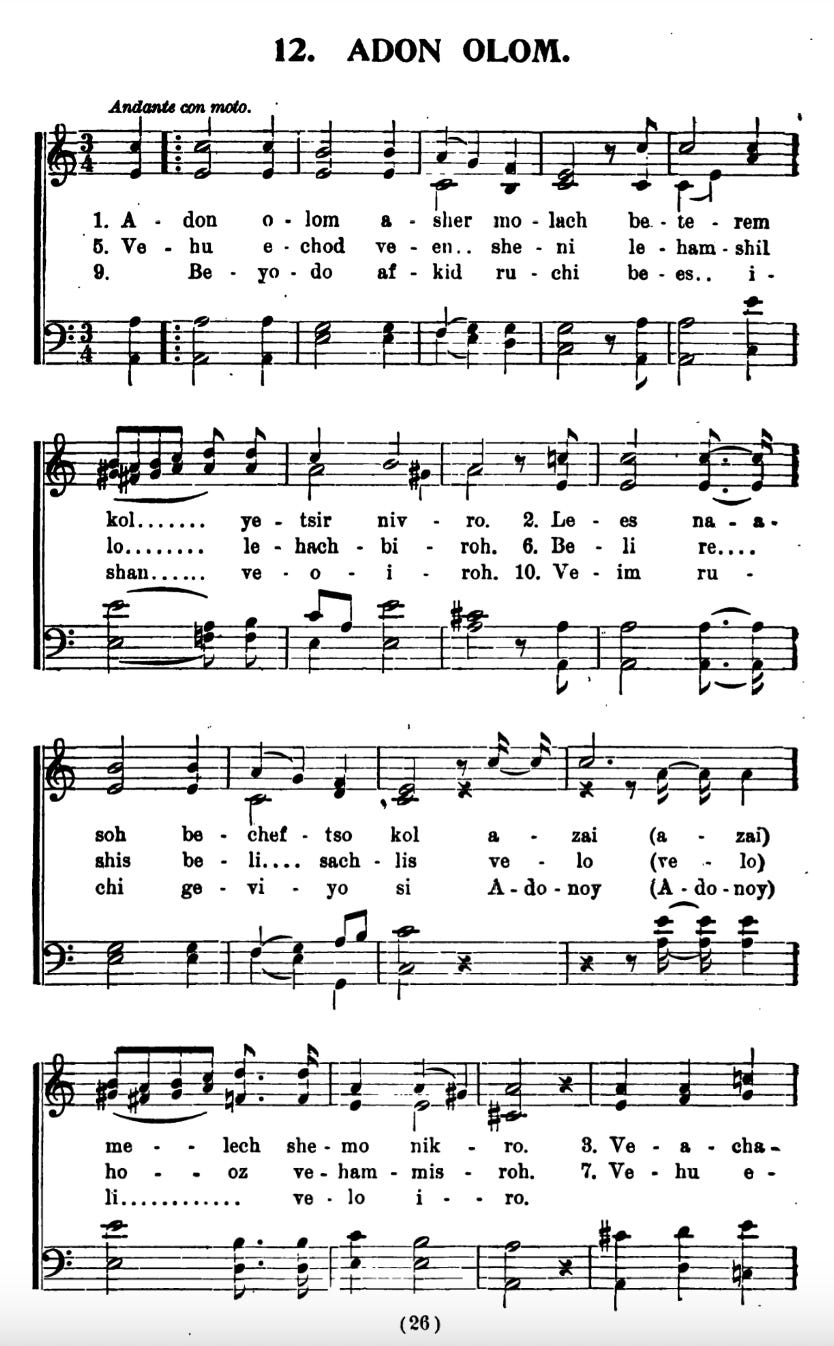
With Naumbourg’s edition, though flawed and replete with errors, Rossi could nevertheless now be heard in the synagogues and concert houses of Europe. However, more than half of the pieces were for 5 or more parts, limiting what a typical synagogue choir could accomplish.4 One piece, however, made a known impact both in the United Kingdom and America: Rossi’s Kaddish, adapted by Naumbourg for Adon Olam, made its way across the British Empire as part of The Voice of Prayer and Praise (1897), the standard hymnal of Anglo-Jewry also known as the “Blue Book.” From there, it was brought to the USA and published in Kol Rinnah: A Hebrew Hymnal for School and Home (1910) by Mathilde Schechter, who enlisted the piece in her quest to improve congregational singing amongst the masses of traditional American Jews who would soon join the Conservative movement.5
In America, Rossi appears to have remained largely obscure (or, in the case of the above Adon Olam, a “one-hit wonder”) until after the Second World War. This institution-building era of American Judaism required its own heroes, and Rossi was long regarded as an impressive candidate. Already in 1950, Alfred Einstein wrote in Hebrew Union College Annual of Rossi’s greatness as a “universal composer” who not only “enriched the Jewish service by his most modern, comprehensive, and remarkable work” but also a “pioneer” in instrumental composition who was “more versatile than his great colleague…Claudio Monteverdi.”6
The Reform and Conservative movements at mid-century sought to elevate the music of the American synagogue and to invest a new generation of cantors as the musical clergy tasked with its stewardship. Within this musical ideology, as Edwin Seroussi points out, Rossi emerged for both movements as “a model of the possible synthesis of Jewish culture in the Diaspora with the surrounding non-Jewish culture through ‘harmonious’ musical composition.” Thus it should be of no surprise that Reform and Conservative interest in Rossi coincided with the founding of their cantorial schools — the School of Sacred Music (est. 1949) and the Cantors Institute (est. 1952).7
The year of 1954 should be remembered as the first great year of Rossi in America. For it was in this year that faculty from both the SSM and Cantors Institute participated in projects that would bring the music of Rossi to new American audiences.
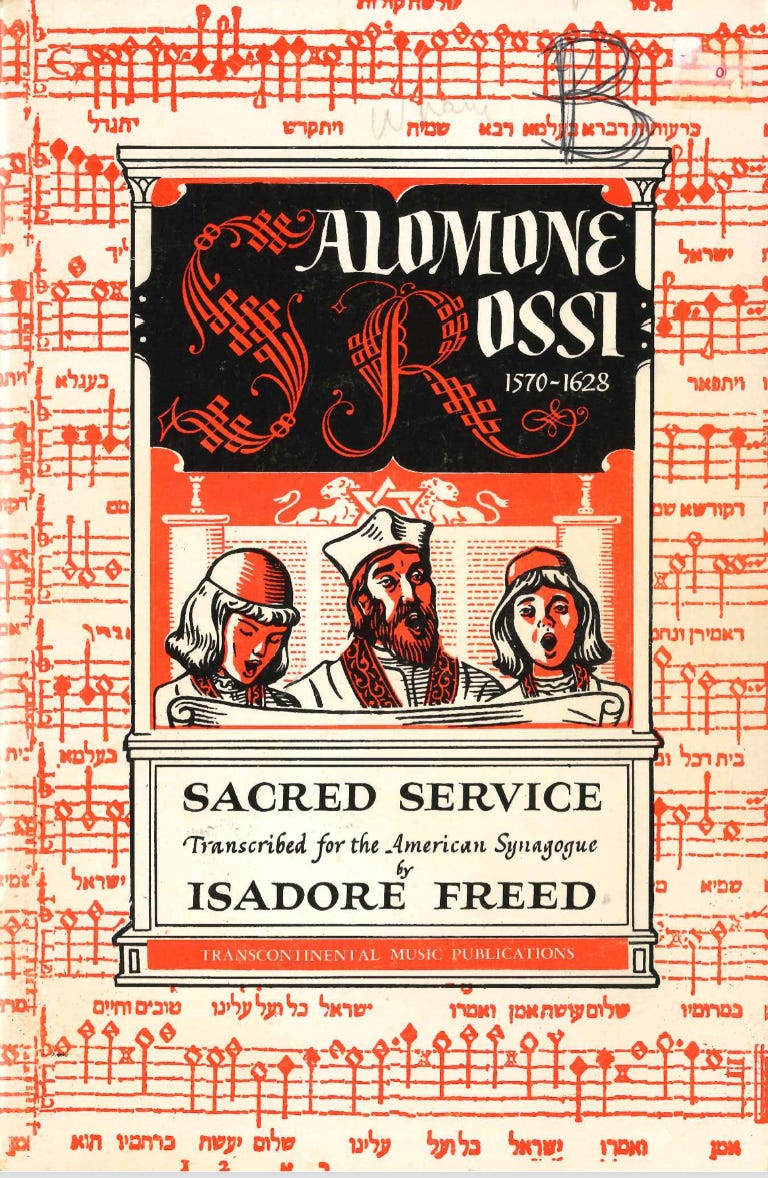
The first of these was the publication of the Salamone Rossi Sacred Service by Isadore Freed, a faculty member of Hebrew Union College’s School of Sacred Music. While attempting to program festival services for his congregation, Temple Israel of Lawrence (NY), Freed found that Naumbourg’s settings of Rossi were unsuitable for both Reform liturgy and for its typical forces of cantor, four-part choir, and organ. Adapting Hashirim for a Reform context, Freed’s publication represented “the first real introduction of this music to American congregations,” providing his students and colleagues a practical way to connect to Rossi’s compositions and legacy.8
But the year 1954 would also hear Rossi resounding in other spaces — not in synagogue, but in the concert hall.
JTS Professor Hugo Weisgall wrote that he first became interested in Rossi as a young college student when his father, Cantor Abba Yosef Weisgall, brought him a copy of the Naumbourg edition.9 Upon joining the faculty at the Cantors Institute of the Jewish Theological Seminary, Weisgall began overseeing a new performance edition of Rossi’s Hashirim Asher Lishlomo under the direction of musicologist and early music devotee, Fritz Rikko. This new edition, unlike Naumbourg’s adaptation, was faithfully transcribed from the original Renaissance source material, held in a complete set of eight partbooks at the Civico Museo Bibliografico Musicale in Bologna, Italy.
Speaking to the Cantors Assembly Convention in June of 1953, Weisgall addressed the assembled cantors on the merits of this “all but forgotten Jewish composer.”10 Lamenting the widespread “neglect” of Rossi, Weisgall took pains to walk his listeners through Rossi’s Hebrew repertoire and its practical use, praising Rossi’s liturgical sensitivity and compositional excellence, including moments of “tone painting worthy of the greatest dramatic masters of his century.”11 But he also tantalized his cantorial audience by mentioning the new edition in process, being assembled by “a graduate student of the Cantors Institute.” It was, in fact, three cantorial students — Raphael Edgar, Morton Kula, and Charles Davidson — who would ultimately assist Rikko with the transcription of the scores from original sources into modern notation over the course of the project.
Yet this moment was not only a dynamic one for these young cantorial graduate students. Although the first volumes of the Rikko edition would not be published until 1967, the scores they generated were being immediately heard in concert halls in New York, the Berkshires, and beyond.
That was due to Hugo Weisgall’s relationship with an up-and-coming conductor and iconic early music enthusiast — Noah Greenberg.
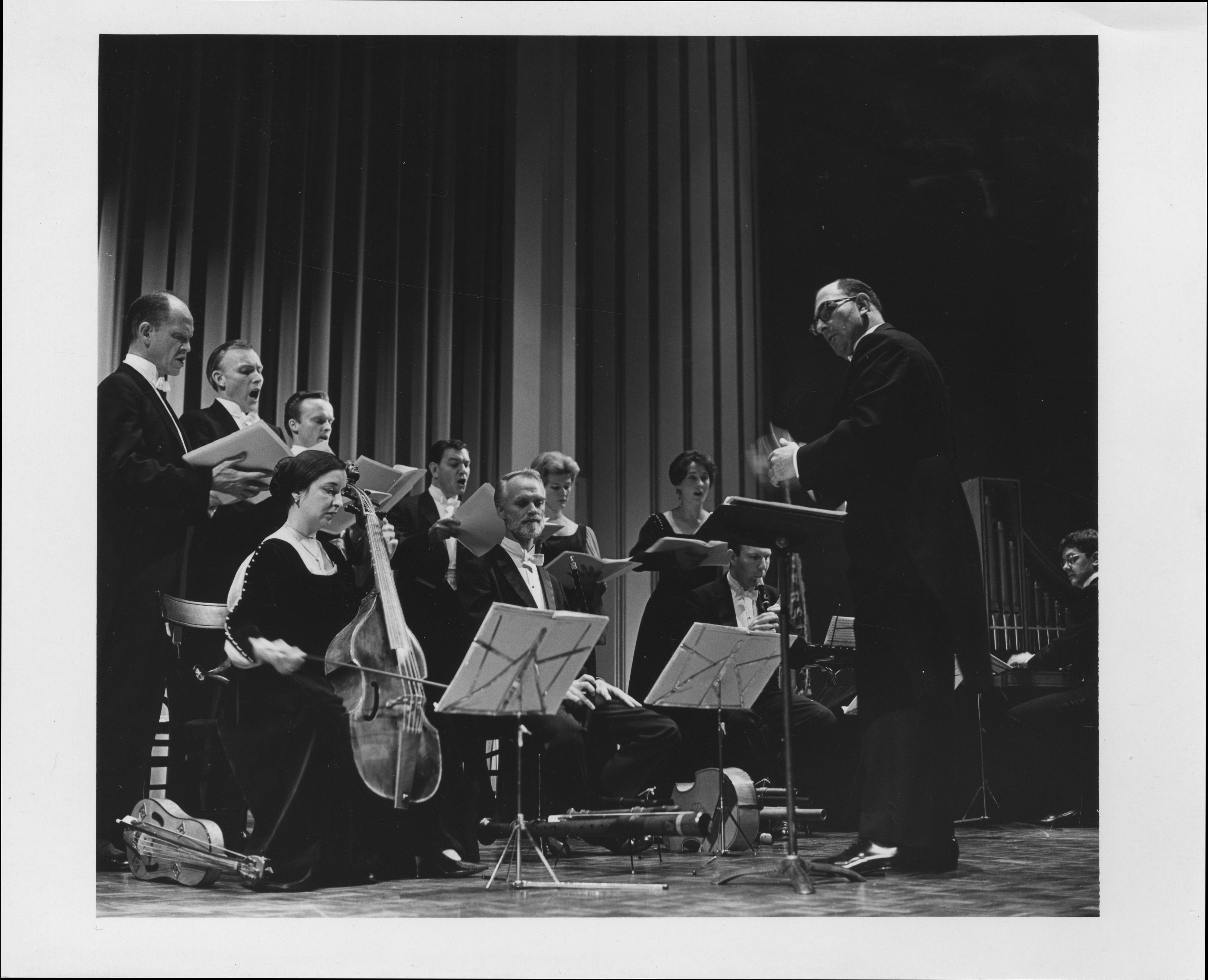
Noah Greenberg (1919-1966) is one of the most fascinating figures I have come upon in classical music history. An effective organizer for the Socialist Workers Party and an amateur choral conductor among the labor-union choruses of New York, he lost his love for politics after a conversion-like encounter to early music at the Bach Festival convened by Pablo Casals at Prades in 1950.12 That experience led him to return to New York and found the New York Pro Musica Antiqua — an ensemble of both amateur and professional musicians who performed Medieval, Renaissance, and Baroque music using period instruments. The atomic rise of this ensemble over 1950s and 1960s is widely credited for inspiring the Early Music movement in America.13
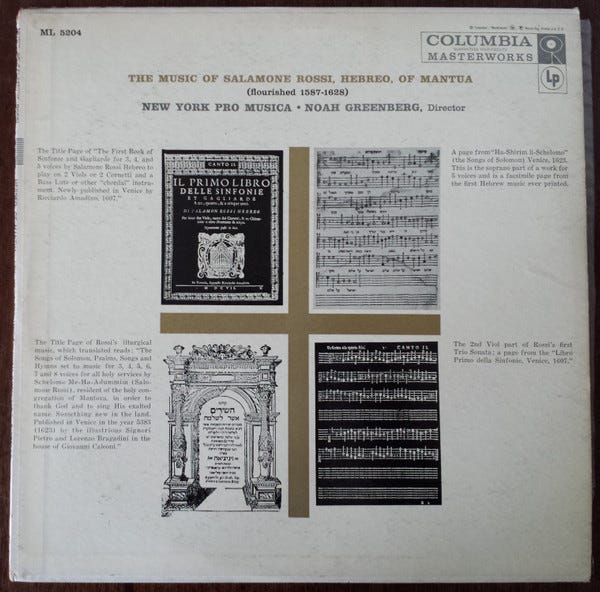
On February 22, 1954, the New York Pro Musica presented a complete concert of “The Music of Salamoni Rossi, Ebreo” at the 92nd Street Y. Billed as “the first all-Rossi program ever presented in the United States” the program included sinfonias, sonatas, Italian madrigals, and of course Hebrew settings from HaShirim. The performance was received with fascination in the Jewish Press, with Rossi identified as “one of the most noteworthy names in Jewish music history.”14 Pro Musica toured with the program for several years, recording it in the studio and releasing it on LP in 1957 — the first all-Rossi recording of the the first all-Rossi concert. And you can listen to the whole thing online (or below for the last track). 15
With the publication of Rikko’s volumes, the gradual publication of new editions, and expansion of the early music movement over the following decades, Rossi would continue to be the object of simmering fascination. This culminated in what Edwin Seroussi termed the “Rossi-mania” of the late-twentieth and early twenty-first centuries: a cavalcade of commercial recordings and YouTube videos in the USA and Europe, cementing Rossi’s place as an “early Jewish cultural icon.”16
This begs the question of proportion — why does Rossi continue to mean so much? Are Jews still looking over their shoulder for Wagnerian digs at their creativity? Does he just fill a need for diversity and minority representation in classical music programming? Or is it that Westernized Jews are still looking to figures who legitimate their stake in the aesthetic legacy of classical music?17
All are likely true to varying degrees. But for me, I see Rossi not in his role as genius but as something more comprehensible — a religious Jew who is a working secular musician. For the majority of his life, Rossi’s worldly compositions and sacred soundscape remained separate musical spheres. Then, at the end of his career, he creates a synthesis. The religious dynamics of this choice are what are most interesting and timeless— what changed in his religious persuasion? Was it a turn towards mysticism? a religious regard for beauty? or a concession to his co-religionists?18
These are questions that still follow any religious musician, whose greatness must derive not from their musical powers or “revolutionary” aesthetics, but from their listening to heavenly voices first. In this way, Rossi’s greatness endures as rapturous music by which one cleaves to the Holy One.
As it is written of such a rapture in the original songs of Solomon (7:7):
How fair you are, how beautiful!
O Love, with all its delights!
For more on this, see my article “Rossi in Moravia: The Rise of Cantorial Professionalism in Czech Lands and Poland-Lithuania in the Seventeenth Century” Journal of Synagogue Music 48/1 (2023): 26-53.
Rossi’s work was mentioned in Christian Wolf’s Bibliotheca Hebraea (1715), which is what brought it to Samuel Naumbourg’s attention. My thanks to Edwin Seroussi for this observation.
Samuel Naumbourg, Cantiques de Salomon Rossi, pp. 19-20, as quoted in Edwin Seroussi, “Reassessing the ‘Great Jewish Composer’: 400 years of Salamone Rossi’s Ha Shirim asher liShlomoh” (2022): 4. This article is deeply indebted to the groundwork laid by this study; For further context on Rossi within the medieval revival of the nineteenth century, see Judith Cohen, “Shlomoh di Rossi – Goralah shel yetzirah – HaShirim Asher LiShlomoh” (“Shlomoh di Rossi – The Fate of a Word — HaShirim Asher LiShlomoh”), Tazlil 9 (1976): 8-14.
The reception and performance of Rossi in Europe between 1877 and 1945 is surely a topic worthy of musicological study.
For more on Mathilde’s hymnal, see my upcoming article for Masorti Journal, “Where The Tunes Come From: The Conservative Movement’s Musical DNA,” due out later this month.
Alfred Einstein, “Salamone Rossi as Composer of Madrigals,” Hebrew Union College Annual 23 /2 (1950): 383–96. http://www.jstor.org/stable/23506640.
For the more on long journey of the Conservative Movement towards founding a cantorial school, a project which was discussed for many decades since the movement’s founding, see Neil W. Levin, “Music at JTS,” Tradition Renewed: A History of the Jewish Theological Seminary (New York: JTS Press, 2014): 719-792.
See also Neil W. Levin, “Salamone Rossi: Sacred Service” Liner Notes (Milken Archive).
See Hugo Weisgall, “Hashirim Asher Lishlomo” Journal of Synagogue Music 1/1 (February 1967): 48.
Hugo Weisgall, “The Synagogue Music of Salamone de Rossi,” Proceedings of the Sixth Annual Conference-Convention of the Cantors Assembly (1953): 31-37.
Weisgall’s keen wit is to be noted in his description of conducting scholarship on obscure topics (ibid):
“The historian in pursuit of secondary source material dealing with relatively obscure subject matter, frequently experiences a strange sensation when suddenly, in the middle of his quest, everything becomes familiar. After a moment he realizes that what is happening is that all his authors are quoting from a single common source. Thus, facts and ideas and as frequently, errors and misconceptions, are repeated by succeeding generations of writers or actually handed down from one to the next. Such is the case with Rossi.”
For more on this, see James Gollin, Pied Piper: The Many Lives of Noah Greenberg (Pendragon Press, 2001): 98-106; Gollin’s biography is a superb and thoroughly-researched account of Greenberg’s life and activities.
A prominent award at the American Musicological Society is still given in Noah Greenberg’s name.
The success of New York Pro Musica Antiqua was not lost on many of Greenberg’s former socialist associates, many of whom were “mugged by reality” and joined the ranks of Jewish neo-Conservatives. One of those former Shachtmanites was Irving Kristol, with whom Noah kept touch even as he later entered the conservative commentariat. It was this memory of Noah’s musical successes that, decades later, inspired Kristol to encourage his friends, Charles and Robyn Krauthammer, to name their own Jewish music education project “Pro Musica Hebraica,” which ran at the Kennedy Center from 2008-2018.
I am currently completing a written account of this worthy project, and hope to shortly have it in print.
See Joseph Gale, “Salamone Rossi’s Music Rates a Top Place in Jewish Music History,” The Indiana Jewish Post and Opinion (March 5, 1954): 8; this article was syndicated in other Jewish newspapers. The New York Times, however, was slightly less effusive. Pushing back against Rossi scholar and New York Pro Musica’s “captive musciologist,” Joel Newman, the Times critic wrote:
“Musically, it was a charming evening, for everything Rossi composed, it seemed, was tender and lovely and the performances under Noah Greenberg’s sensitive direction had the gentleness, skill and linear clarity for which his group is already noted. But it hardly succeeded in proving the program claim of Joel Newman that Rossi was “one of the greatest Jewish composers in music history.”
Those who are used to straight-tone Renaissance singing will be in for an awakening. Indeed, the tempi and texture are very different from contemporary Renaissance aesthetics. But they capture an enchanting sense of movement not often in the contemporary world of seamless counterpoint.
Seroussi, “Great Jewish Composer,” 20.
For Seroussi, this undue focus represents a eurocentricsm that obscures even more impactful Jewish figures, such as the Ottoman-Jewish composers Avtalyon and Tamburi Izaak, whose Ottoman compositions have had a far much greater impact in Turkish society than Rossi’s in Italy.
Some off these details of Rossi’s outlook can be found in the introduction to his Hebrew madrigals, here translated by Don Hárran: https://www.posenlibrary.com/entry/introduction-salamone-de-rossis-ha-shirim-asher-li-shelomoh-songs-solomon
Another wonderful and enriching essay. Also, the effort of putting in the YouTube materials is appreciated.
Thank you for this wonderful article. I’m still relatively new to the world of classical music, but it informs my daily prayer. To find this liturgy in Hebrew feels magical. Will dive into Rossi with gusto