
Scrutonizing the Synagogue
A Review of "The Death and Life of Nusah" by Charles Heller

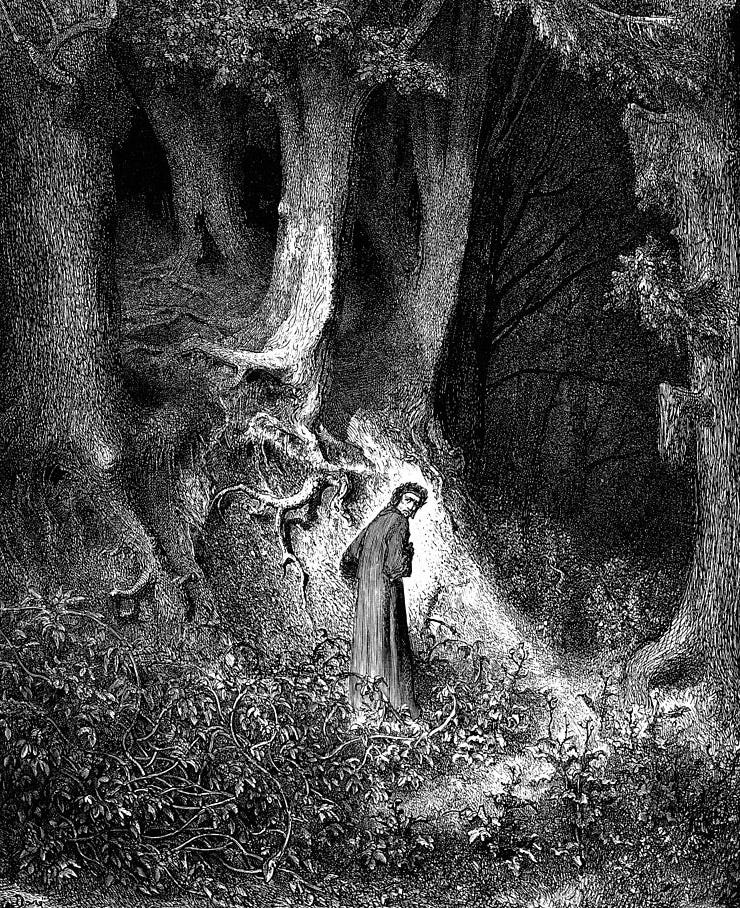
The author Hussein Aboubakr Mansour recently penned a contemporary sequel to the Divine Comedy in which he depicts Dante confronting the lord of nihilism, Friedrich Nietzsche. After witnessing a ghoulish parade of postmodern thinkers, the devastated Dante spies a pitiful man, weeping. Nietzsche sneers:
“That one? They call him Scruton. He is the final man, the last advocate of chains—the tender of embers. He warms himself by corpses. He is nostalgia’s priest, like you, living in tombs—too weak to dance, too weak to build. Pity him not; his flame is rot.”
Nietzsche leans closer. “His flame offers neither heat nor thaw, for it is kindled by memory and regret alone—not by will, nor by the living flame of creation. His is the delicate glow of decay, the fading twilight of nostalgia. Do not pity him, poet. His soul is the most sterile of all, unable to create anew. He remains on this frozen lake because he still believes in a lie—the oldest lie of all: that the butterfly alone can build a bridge beyond this abyss to his lost somewhere.”
Mansour’s antagonist here scorns the figure of the late British philosopher, Sir Roger Scruton (1944-2020), a revered public conservative and advocate for Western culture. While Mansour is presumably sympathetic to the subject of his caricature, he uses Nietzsche’s demonic accusations to point out the weaknesses he perceives in Scruton’s writing: a worship of frozen cultural forms and, perhaps, an impotent program of action to realize his great dreams in the face of a lost culture.
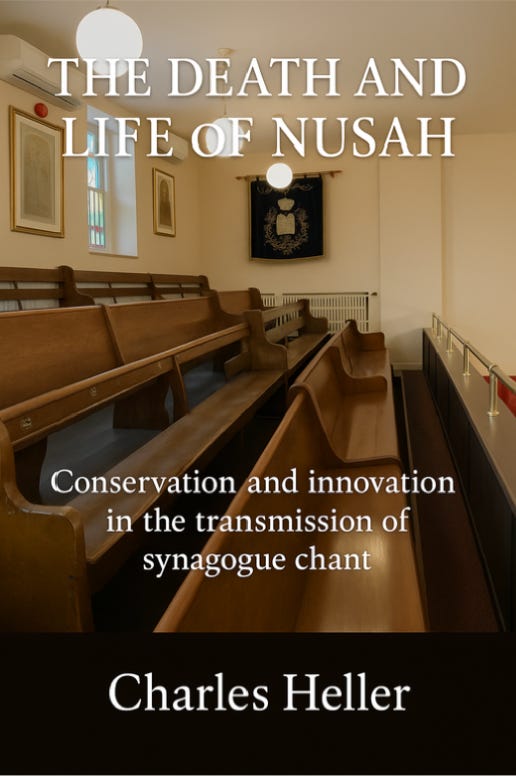
To begin this review of Charles Heller’s The Death and Life of Nusah with a modern critique of Roger Scruton is to furnish the former with great praise. Heller, like Scruton, is a leading defender of tradition — both of Western culture and of the Ashkenazic synagogue. He has fought on the front lines of the Jewish worship wars for five decades, serving as a cantor, music director, accompanist, composer, and educator, advocating for tasteful Jewish music and traditional cantorial style.
Heller has also sharply wielded the pen upon the battlefield of ideas, contributing frequently to the Journal of Synagogue Music and authoring two previous books: What to Listen for in Jewish Music (2006) and Shul Going: 2500 Years of Impressions and Reflections on Visits to the Synagogue (2019). These early volumes reflect Heller’s keen understanding of the structure of Ashkenazi synagogue music, as well as his broad knowledge of historical sources which give texture to those received traditions. His latest book, The Death and Life of Nusah: Conservation and Innovation in the Transmission of Synagogue Chant (European Cantors Association, 2025), displays both aspects of his erudition, dynamically exploring the beautiful inner workings of nusah while describing the factors leading to its healthy transmission and, in our own era, to its decline.
The book opens with a short introduction describing its overall strategy: (1) to chart the modern challenges to the millenium-old edifice of traditional Ashkenazic chant (nusah); (2) to describe the form and function of nusah and how it evolves, both properly and improperly; and (3) to advocate for traditional nusah and the benefits of the synagogue service. Heller makes this case from a Scrutonian vantage point, paralleling the decay of Ashkenazic music and Western classical music due to secularization, decolonization, and musical “dumbing down.”
Heller defines nusah as “the traditional application of synagogue melodies to the liturgy.” Composed of an amalgam of Ashkenazic prayer modes, motifs, and melodies, the purpose of nusah is “to unite the community through a shared awareness of time and place.” This goal is shared, the author posits, with musical systems from other cultures, including ancient Greek modes, Indian ragas, Arabic maqam, and Catholic plainchant. The creation of such repertoires allows a population to achieve unity of song and purpose across a wide geography.
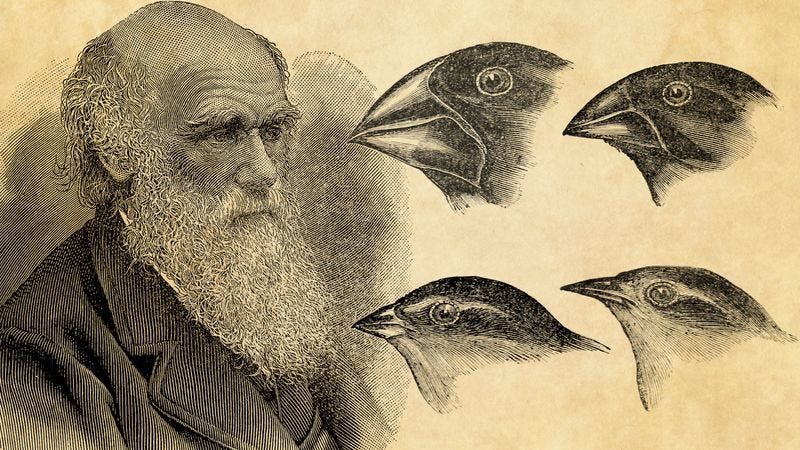
Heller and Scruton are both distinctive by their use of broad disciplines to explicate the beautiful and the good. Thus the most ingenious conceit of Heller’s book lies in its use of Darwinian theory. “Selection is the key to our understanding of how nusah is transmitted,” writes Heller, taking the reader through evolutionary theory and its application to the realm of synagogue music. Dispensing with nineteenth-century theories of folk music as expressing the mystical qualities of a national soul, Heller instead embraces a scientific approach, using concepts like preadaptation, the founder effect, and mimetics to explain musical change.1 His argument thereby transcends overused abstractions like “heritage” and “tradition,” opting instead to view nusah as a living organism gradually evolving over time.
If nusah is a living organism then change is inevitable. The art is to manage that change in a controlled, acceptable way.” —Charles Heller
Heller first attributes the endangering of the nusah species to lay prayer leaders who, in an increasingly secularized society, have less exposure to the richness and complexity of the Ashkenazi musical tradition. In the orthodox world, Heller indicts the custom of appointing mourners or untrained laypeople to lead the service, many of whom introduce “inappropriate, non-traditional material” with little connection to the nusah. “As the old witticism goes: Losing a parent makes you a mourner, not a hazzan.” Outside of orthodoxy, Heller points the typical finger at Jewish summer camps, where the compositions of folk artists like Shlomo Carlebach and Debbie Friedman have supplanted the traditional cultural and musical hierarchies atop which the educated cantor once stood. What remains of this endangered nusah is its most basic, lay-accessible form, stripped of the precious depth and dynamism it acquired over a thousand years of evolution.
Yet Heller also passes judgement on the supposed caretakers of this living tradition — the cantors. He firstly conceives of the natural evolution of nusah as comprising a perennial tension between masses and elites — i.e. between congregants and cantors. The latter serve as nusah’s fundamental conservators and gatekeepers, charged with integrating acceptable innovations and rejecting unacceptable ones. Yet Heller indicts the contemporary cantorate for largely abdicating this role, exchanging conservatism for innovation and “weaken[ing] the impact of a tradition that is the product of generations of selection.” While acknowledging and exploring the human need for novelty, Heller advocates for its actualization through nusah artistry and tasteful adaptation — not through pandering to the lowest common musical denominator.
Among the strongest aspects of Heller’s writing are his descriptions of the techniques utilized by faithful cantors who fulfill their dual roles as watchful preservationists and mindful innovators. Both the second chapter (“Nusah”) and third chapter (“Case Study: Shabbat Musaf”) notate and explicate such forms of hazzanut and successful congregational repertoire, as well as contrast effective and ineffective melodic choices. The third chapter is particularly focused on this endeavor, walking the reader through cantorial tactics for segments of the Musaf service (more of Heller’s comprehensive knowledge would have been most welcome here to give a complete portrait of that service). These sections, in the aggregate, should be read by cantors and prayer leaders with much profit for their sacred craft.
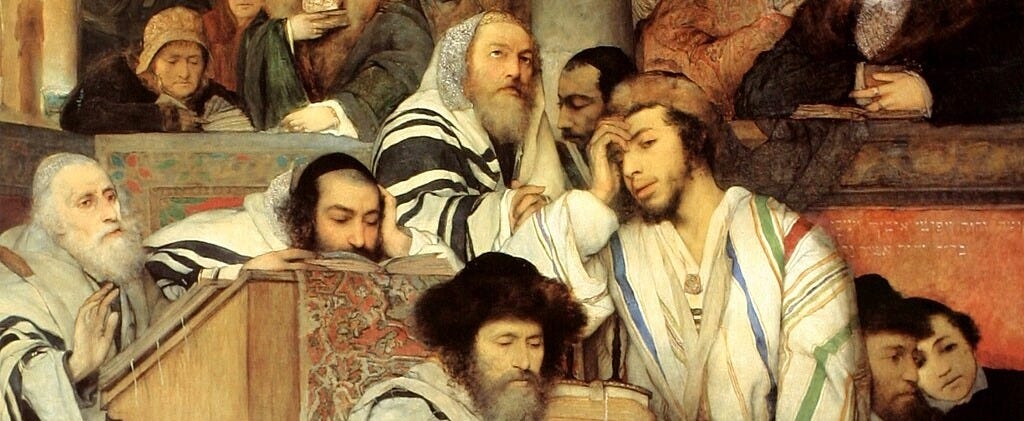
Heller’s polemical tone rears its head when evaluating “acceptable tunes” for the synagogue. His criteria for such tunes are twofold: (1) they should match or complement the nusah; and (2) they should not have cheap or inappropriate associations. Thus the Lubavitcher use of “La Marseillaise” for ne’ilah and Leonard Cohen’s “Who By Fire” for berosh hashanah yikatevun are deemed acceptable for the High Holy Days due to their rich subtexts, whereas the romantic ballad “Greensleeves” is firmly rejected. Heller’s ambiguous cases are particularly telling: mimkom’kha to the Neapolitan song “Torna a Surriento” and the kedusha set to melodies from Carmen are both assessed as “maybe” appropriate, yet the latter is invalidated if one knows the story behind the opera. Football team fight songs for Adon Olam are also approved due to their longstanding use among passionate sports fans on Sabbath gamedays.
These and other curious in-between cases reveal the deeper loyalties of the author. Fealty to local sports and classical music are often the marks of the cultured Jew in the West. Solomon Schechter, the legendary Anglo-Jewish scholar who inspired the Conservative/Masorti movement, famously advocated sports knowledge to future American rabbis, advising the young Louis Finkelstein: “Unless you can play baseball, you’ll never get to be a rabbi in America.” Such loyalties display a sense of Western-Jewish doikayt — a civic patriotism for one’s place, be it in the concert hall or the stadium. This has been the case wherever Jews have prospered, whether in sixteenth-century Poland, seventeenth-century Amsterdam, nineteenth-century Germany, or twentieth-century America and Britain.

Yet it is hard to avoid the fact that both of these arenas — the opera house and the football pitch — represent lifestyles which often live in tension with Jewish observance. The use of operatic and sports tunes thus derives not from religious sentiment, but from an attempt to resolve this perennial tension through remissive admixture. Such an act of cultural peacemaking keeps these contrafacts in the author’s good graces, whereas others listed in the book are damned among a litany of other “nusah crimes.”
Though easy, popular melodies are often described in our era as the key to “participation” in the synagogue, Heller rejects this familiar trope outright. He instead points to nusah itself as the truly unifying aspect of the service, as it facilitates common responses, feelings, and a sense of shared time and place. Rabbi Abraham Joshua Heschel’s own remarks from his famous lecture, “The Vocation of the Cantor” (quoted by Heller), echo this cantorial ideal: “To pray without nusah is to forfeit the active participation of the community. People may not be able to pray; they are all able to chant. And chant leads to prayer.”
A short fourth chapter, “Oral versus Written Transmission,” provides an informative portrait of how orality created the building blocks of the musical language of nusah long before it was systematized or written down. Heller’s observations are well-supported, as elsewhere, by appeals to other theorists, especially the writings of English folk song collector Cecil Sharp (1859-1924). This section furthers the book’s success in illuminating the often-opaque structure and evolution of nusah by putting it in dialogue with studies of world music cultures, past and present.

The book’s final substantial chapter, “The Role of the Synagogue in Community Cohesion,” attempts to set the raison d’être of nusah on firm ground. Heller here touts the social and psychological benefits of the synagogue service, in addition to its spiritual goods like expressing wonder and gratitude and achieving a sense of well-being. The community building aspect, however, stands out as the primary purpose of the whole exercise. Heller writes:
“Communal prayer has a social function that is made more vivid through ritual. The use of standardized words and tunes creates a ritualized performance. And the purpose of ritual is to create cohesion in the community, leading to trust and cooperation between its members.”
Yet newer generations of worshipers “remain believers but not belongers,” retaining their own personal belief system without the need for traditional community. Surveying what appears to be a wasteland of modern experiments, Heller bemoans new enterprises such as BASE Hillel, Jewish farming with Earth-based spirituality, and contemporary havurot, all of which “offer communal ritual without the trappings of the synagogue service.” Such innovations are characterized as departing entirely from the shared cultural covenant which created and sustained Ashkenazi nusah for centuries. This abandonment is accelerated, Heller adds, by the strategies of synagogue leaders who “have interpreted the loss of members as indicating a need to change the service and abandon traditional forms of worship.” Tragically, “people attending services have not been exposed to these traditions and are encouraged to reject them without actually knowing what they are.”
While appearing to have answered his final rhetorical question and chapter title, “The Death of Nusah?”, Heller attempts to leave the door open to the future. After all, “the feeling of wanting to be with others in a synagogue has not gone away.” Spurred on by tragedies like the Tree of Life Synagogue, COVID-19, and October 7th, the author has witnessed many return to the synagogue, longing for that sense of belonging which anchors his idealized community of nusah. As Heller sums up:
“When all is said and done, the basic human need for people to come together remains, and the synagogue waits for them. For those who come to the synagogue, the rich heritage of traditional nusah will be there to enrich the experience.”

Reflecting on the book’s conclusion, I cannot help but return to Mansour’s Dante-inspired vision of Roger Scruton. For in reflecting on Scruton’s conservatism, Mansour reveals that which it lacked: the loving and commanding presence of God. Scruton was a sort of Christian, but he based his arguments in broader, humanistic values that he hoped could be appreciated by the atheist and the agnostic alike. His appeals were to natural conservative impulses, but not inherently to religious ones.
This is an admirable, if twentieth-century solution to the problem of meaning. For when free people could no longer be united around shared ethics, the hope became that they could become united through shared aesthetics. These would allow us to surpass our differences and sing together, ultimately pointing towards reconciliation and brotherhood. It is this faith in the peace-making ability of national aesthetics that has driven the modern West for the last century and which is constantly implicit in its cultural sector. From the synagogue to the nation-state, we dared to hope that resurrecting a beautiful musical past created by the honored dead could unite our communities —and countries— in an uncertain future.
Yet the story told by Heller’s book demonstrates the ever-chilling embers of this promised fire. While secularization and the modern attack on high culture are partly to blame for the musical atrophy of the service, the simple fact is that twenty-first century Jew can acquire a sense of belonging in other ways, for good and for ill. Nusah-based music can ennoble and enrich one’s life, but without an existential grounding in religious commitment, the whole edifice becomes its own stadium and concert hall, even when enhanced by choral harmony, cantorial artistry, or communal singing. To invite someone into the nusah tradition in the twenty-first century requires an appeal to something higher.
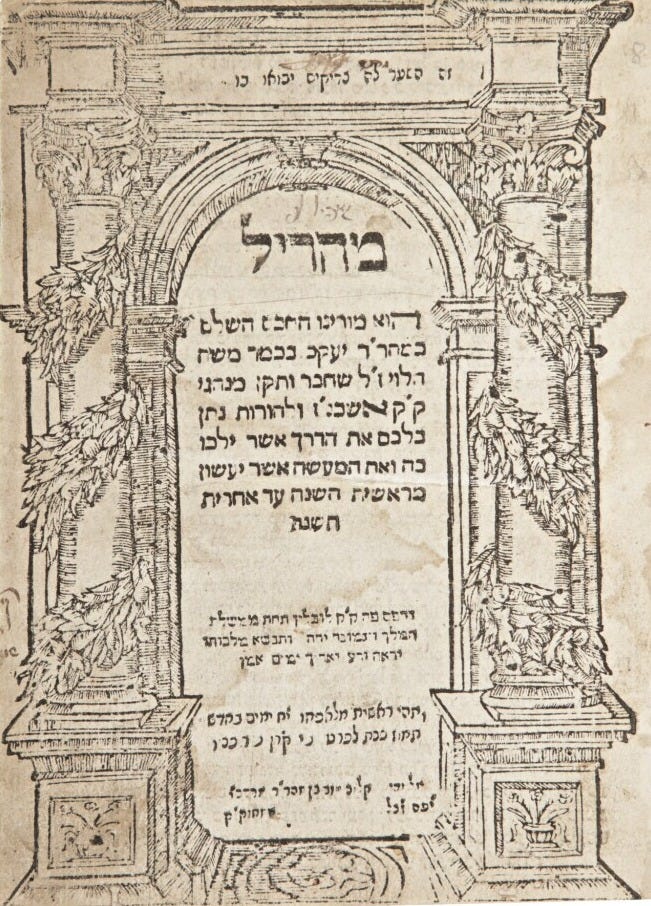
Judaism does have language for the religious impulse behind Heller’s Scrutonian conservatism. It is called minhag — a series of accepted religious customs organized around a Jewish ethnic subgroup, be it Italian, Yemenite, Romaniote, or any variety of Sephardic or Ashkenazic Jewry. Though Heller attempts to use the term “nusah” to encompass these religiously-mediated and culturally canonized folkways, minhag is the correct word. It is the cantorial term “nusah,” in fact, which is a borrowing from the language of minhag, originally referring to the version of the prayers which is statutory for each Jewish ethnic group. Because of its long continuity and conservative medieval rulings, Ashkenazic minhag has always been given great weight, sometimes even over that of law itself. The classic call to heritage among Ashkenazic Jews has thus always been a religious one, proclaiming minhag avoteinu b’yadeinu: the custom of our ancestors is in our hands.2
Counter to Heller’s heroic ideal, cantors have not always been loyal protectors of Ashkenazic minhag. Between the fifteenth and nineteenth centuries, cantors were just as likely to profane old customs and innovate new ones as they were to preserve traditional melodies. Although a canonical body of Ashkenazi melodies is evident as early as the fifteenth century and again by the late-sixteenth century, the increasing independence of the Ashkenazic cantorate from its rabbinate in early modernity caused a wellspring of innovation and the expansion of Ashkenazic custom.3 This occurred much to the chagrin of rabbis, who were the original preservers of traditional melody. The ideal of cantorial nusah conservatorship came during the nineteenth century, during which the modern cantors like Salomon Sulzer emerged to “purify” the nusah tradition from years of ornamental accretions and to preserve its “authentic” Jewish national spirit. It is when cantors assumed the mantle of professionalism that they “switched sides,” leaving populism behind for the elite musical stewardship familiar from Heller’s book.

Whether or not Charles Heller’s anatomy of premodern change in the Ashkenazic nusah tradition is correct, his diagnoses of the form, function, and problems of the tradition today are spot on. The question remains — is there more to this millenium-old inheritance than aesthetic beauty and social cohesion?
While on an academic fellowship at Oxford several years ago, I saw an advertisement for one of the children’s choirs attached to a prominent college chapel. This ensemble sang angelic Anglican hymns each week with immeasurable beauty. Describing their experience, the young choral scholars and their directors lauded the choir as a great social outlet which gave the children a good music education. But incredibly, the advert did not once mention the person to Whom the beautiful music was all ultimately addressed. Like Heller’s own estimation of the synagogue service, the ancillary benefits of the choir were far more natural to advertise than the child’s introduction to faith, prayer, and Scripture by being part of a beautiful, musical religious service.
This is the tragedy shared by both chazonus and much of Western music: forgetting its intended recipient. The worship of frozen aesthetics rather than using their stirring warmth to point us to the existential fires of faith.
I deeply share Charles Heller’s love of nusah and belief in its inherent goodness. We share affinity for the same high cultures — traditional chazonus and classical music — particularly as exemplified by the United Kingdom and its downstream cultural daughters in the Commonwealth. And although I spent many years as a young gadfly championing neo-hasidic synagogue repertoire (which I still use regularly), now in early-middle age I find myself ever more drawn to the old cantorial ways. Hazzanut holds the promise of discovering God within musical complexity, expressing the soul of the liturgical words through its Ashkenazi liturgical jazz. In our internet age, it is not difficult to find the prophets and repertoires of Jewish music’s new geist. But the depths of nusah and hazzanut now represent an or ganuz — a hidden light requiring time and effort to master, challenging both one’s voice and one’s spirit to go deeper into the words of prayer.
The invitation of nusah is not only to community, but to a radical attention to liturgy and to one’s relationship with God. As Yosef Lindell concluded in his recent article on the evolution of the cantor’s role:
“We are commanded to glorify and beautify G-d through the performance of mitzvot (see Rashi, Sukkah 29b). This ideal should apply to tefillah no less than to a gleaming Torah crown or a flawless etrog."4
The Death and Life of Nusah is a wonderful and provocative guide to this rich tradition. But for it to survive in any respectable form, we must return to the existential and religious sentiments which first animated its creation and which coarse vividly through its prayerful words.
Nusah, like a nation, cannot endure simply as a covenant of aesthetics. Even the most beautiful of such bonds eventually grows brittle and cold, unable to defend against the hot passions of a new, unbridled age.
Instead of pondering its death, advocates of nusah must choose life, grounding the practice of nusah in the Eternal. Rejecting death, we must boldly proclaim: lo amut, ki echyeh va’asaper ma’asei yah —“I shall not die, but I shall live and tell of the deeds of the Lord.”
The Death and Life of Nusah by Charles Heller is available for purchase from the European Cantors Assocation.
To purchase a download (pre-launch price £10, from 1 November, £15), please email nusah.book@cantors.eu
To purchase a printed copy (pre-launch price £15, from 1 November, £20) including postage and packing from geraldine@cantors.eu.
I found Heller’s example of the founder effect quite applicable in analyzing my own synagogue’s musical traditions. Our community’s beloved founding rabbi grew up in a small Jewish community in upstate Michigan which was influenced by German-Jewish tradition. When I arrived to interview, I discovered that the community had a completely unique tune for the Ein Kamocha, which was, although in a major key, was unlike the ubiquitous tune by Salomon Sulzer. I asked the rabbi, and he said that it came from his childhood in Michigan. Since the rabbi functioned as the chief prayer leader and weekly leader of the Torah service, his own musical DNA became imprinted onto that part of the service, causing, as in the founder effect, a distinctive feature isolated from the broader trends in the population. The end result is that our community benefits from a distinctive Torah service melody, adding to its uniqueness.
The impulse to preserve these folkways is strong, even if a custom has long-since been proven to be in error. This is the case with the Ashkenazic prohibition against kitniyot on Passover — its original reasons for prohibition were obscured even from the medieval sages. Since rice and legumes are no longer stored with possible leavened products, the overarching reason for the practice rested on the default preservation of custom and whether there were serious and compelling reasons to change it. The question of whether eating kitniyot met these criteria was at the heart of a recent responsum permitting them for the majority-Ashkenazic Conservative/Masorti movement in the diaspora (it had long been permitted in Israel due to it being the accepted custom of Israel’s majority non-Ashkenazic population). The dissenting opinion particularly highlights the weight of custom in Jewish life.
See Matthew Austerklein, “Rossi in Moravia: The Rise of Cantorial Professionalism in Bohemian Lands and Poland-Lithuania in the Seventeenth Century,” Journal of Synagogue Music, September 2023 (5784) 48/1: 26-53.
This article from Jewish Action magazine also became famous for unintentionally including a banner of music notes for “We Wish You a Merry Christmas.” The response by Rabbi Gil Student, the magazine’s editor, remains an excellent (and humorous) example of public teshuva.
My thanks to Joshua Blustein, who gave helpful comments to an early draft of this review.
It’s premature to point fingers why, but let us also acknowledge the fall of Awe, Respect for Something Grander, Fear of Authority, and Kindness Towards All.
We are trying to shore up the walls, when the people sharing the space are the ones eroding.
This is such a rich discussion, I want to read the book. It also made me think of Hazzan Richard Kaplan, z"l.
How little we know about the intersection between music, continuity, drawing people in, keeping them engaged, prayer, and God. How people choose which shul to go to or which to never set foot in again can be impacted by their musical experience there, even if they can't put their finger on it.
Or it can have nothing to do with the music. When I was very small, maybe 3 or not quite, in the chapel of Beth Shalom in Pittsburgh, Cantor Moshe Taube was singing Hoshana Rabba. I stood on the chair with my fingers in my ears, saying "stop that singing" loud enough that my mother had to grab me and rush out in embarrassment. She was new in town and it was her mother's yahrzeit. Needless to say she never went back to that shul in the seven years we lived there.
I have an ongoing conversation with a woman in my community about why she doesn't come to shul. She says she wants to be able to ask me questions during the service. Why are the prayers in this order? Why does she remember things differently from her childhood? Why are we willing to exchange one prayer for a modern poem one time but not another? She has three small kids and manages a busy ecotourism center, she tells me she doesn't have much time to talk or study about these questions otherwise. I have tried to tell her that ritual is like theater, it's not the time to ask the questions.