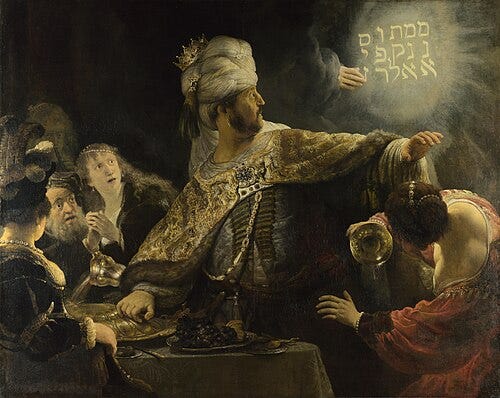
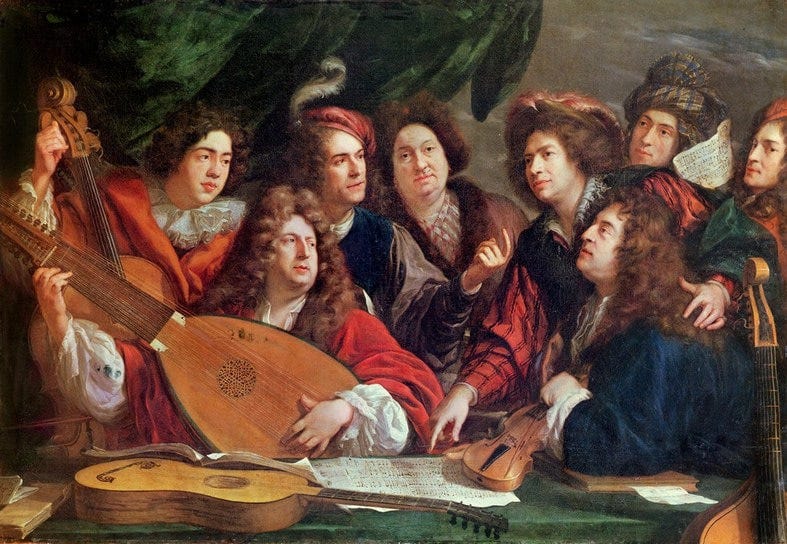
Rembrandt, Belshazzar’s Feast (1635). The Dutch painter was heavily influenced by the chiaroscuro technique of Caravaggio.
Chiaroscurois Italian for “light-dark.” Exemplified by Caravaggio’s Italian masterworks, this artistic technique conjures a complementarity of vivid brilliance and abyssal shadow, emphasizing both knowledge and mystery in the tension between that which is hidden and illuminated.
It is also a good metaphor for Italy itself.
Italian Jewish history (and music) is brilliant with color and texture, dating back nearly two thousand years. Italy’s Jews have been a constant companion to the evolution of Italian culture and participated deeply in its intellectual life during the Renaissance, engaging with commerce, culture, and new ideas (even when confined by the walls of the “ghetto.”) The Jews of Italy are also incredibly diverse, featuring Ashkenazic, Sephardic, and Italian subcommunities, each with its own synagogues and hyperlocal Jewish musical customs according to their city and region.
Yet Italian history is also darkened by many periods of libels, persecutions, and contemporary worries.
My first (and only) visit to Italy was itself a mixed bag of light and dark. While studying abroad in Vienna as a college junior, my travel companion and I booked a spring break journey through the south of Italy, spanning Sorrento, Amalfi, Pompeii, Naples, Palermo, and finally ending in Rome. It was an amazing itinerary replete with history, great food, museums, and memorable Shabbat services on an island in the middle of the Tiber River. I even got to observe Pope John Paul II’s final Easter Mass (a story for another time).
Yet within the week, my travel companion and I were also threatened with gun violence by a mobster’s kid; subjected to ethnic slurs due to our hairstyles (Afro and Jewfro, respectively) on the commuter rail to Pompeii; almost hurled on a topsy-turvy bus ride along the jagged Amalfi coastline; and engaged in a trial of sheer will while locked overnight in our train cabin between Palermo to Rome — without egress for bodily relief.
It was the best of times, it was the worst of times.
Fortunately, I come today with more chiaro than scuro — and with a report on some new horizons in Italian Jewish music.
The first is to remind those interested in Italian-Jewish music that a very unique and unprecedented resource exists online — the Thesaurus of Jewish-Italian Liturgical Music. Created by my colleagues Piergabriele Mancuso and Enrico Fink, with help from the inimitable Edwin Seroussi and other scholars, the site represents a rich, searchable sound archive hosting ethnographic recordings of diverse Italian Jewish musical customs from all over Italy and across the Jewish liturgical year. As its creators write:
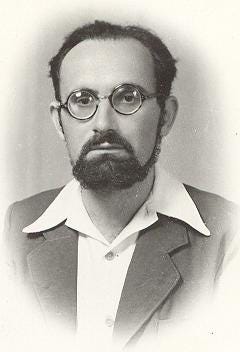
Leo Levi, pioneering musicologist of Italian Jewish music.
“The Thesaurus, as we often remark, is inspired by the research path traced by Leo Levi (1912–1982), a fascinating pioneer of Italian ethnomusicology; we try to embrace his investigative spirit and, above all, seek to identify the modes and timing of the evolution of the musical repertoire of Italian Jews. At a time when large sections of our society struggle — and sometimes fail entirely — to engage in dialogue with Jewish culture and traditions, the Thesaurus remains a testimony to the centuries of Judeo‑Christian coexistence, the dialectical relationship along which Levi structured much of his mission.”
The project’s most recent news is its successful collaboration with the Biblioteca Teresiana in Mantua, which has freshly digitized the musical archive of the Mantuan Jewish community, bringing the number of items in the Thesaurus to a staggering two-thousand five-hundred. For anyone of Italian-Jewish ancestry or curiosity, the site will not disappoint in its depth and scope.
On a more practical level, here’s a melody from the Thesaurus that you can bring to your Passover seder. I first learned this “Ki Lo Na’eh,” a song from the end of the seder, from Enrico Fink himself while we were fellows at Oxford University. He described it as a “tarantella” — a type of Southern Italian folk dance. This ethnographic recording, recorded by Ferrarese cantor and Buchenwald survivor Carlo Schoenheit detto Carluccio (b.1900), comes from the city’s Ashkenazic tradition.
0:00
-4:44
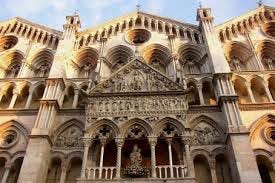
Ferrara is not only home to this lusty tarantella for Passover. It is a long-regarded center of musical innovation in Italian history — one in which Jews played a significant part. Guglielmo Ebreo de Pesaro (c.1420-c.1484), who worked in the court at Ferrara was one of its most famous dance instructors. The Este court where de Pesaro worked was also one which invested heavily in music, and which, under “First Lady of the Renaissance” Duchess Isabella D’Este (1475-1539), later engaged many newly-arrived Sephardic immigrants in the production of music and musical instruments.1 It was also in Ferrara where Rabbi Leon de Modena, future rabbinic patron of the Jewish madrigalist, Salomoni Rossi (1570-1630), first experimented with art music in the synagogue in 1605, drawing local opposition and inspiring his Jewish legal ruling (“psak”) on the matter which would later be published as the preface to Rossi’s Hebrew madrigal part books.
To give your ear a front seat to the music of Ferrara, Jewish and otherwise, I recommend tuning into the concert livestream of “Ferrara: Splendor of the Renaissance” by Piffaro, Philadelphia’s Renaissance band, Piffaro. With an ambitious and thoughtful program organized by artistic director Priscilla Herreid, the concert offers several Gugliemo de Pesaro and Salamoni Rossi selections arranged for early wind ensemble, sounding within a musical journey through three centuries of Ferrarese musical creativity and lively arrangements of works by Domenico da Piacenza, Josquin des Prez, Cipriano de Rore, Joan Ambrosio Dalza, and Carlo Gesualdo.
The program also importantly explores Rossi not only in his Jewish works, but in his broader contributions to the evolution of Renaissance music. Two instrumental Rossi pieces featured in the concert, ‘Sinfonia grave’ and ‘Gagliarda detta l’Andreasina,’ “are examples of the evolution of instrumental styles like the canzona into – eventually – the trio sonata of the Baroque era.” The livestream features Pifarro’s dizzying array of period instruments, dependably vivacious musicianship, and professional videography. You can preview the full program book here, and buy livestream tickets here, which are available only through April 9th.
Here’s one last tale for you from the annals of Italian-Jewish music, and from the cantorial history of Ferrara no less. And I am publishing about it here for the very first time.
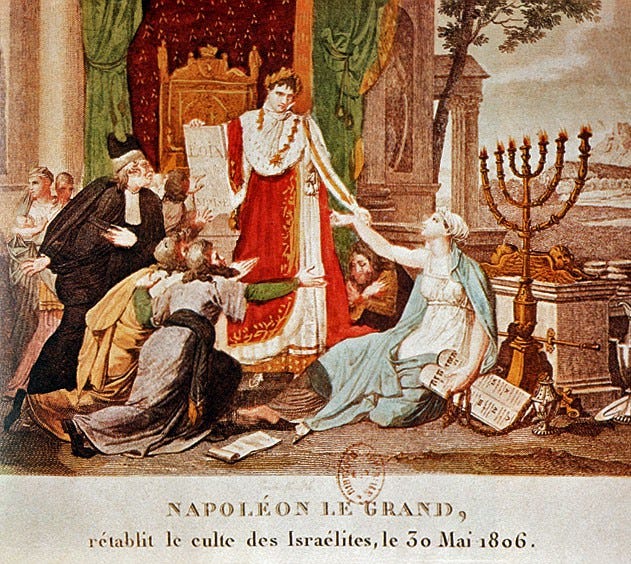
The conquests of Napoleon Bonaparte (1796-1815) were one of the principal engines of Jewish emancipation across European history. The general-turned-emperor’s enlightened perspective brought down the walls of the ghettos, offering new rights and freedoms to Jews as imperial citizens. Seeking to assimilate them under his dominion, Napoleon even convened a Grand Sanhedrin (1806-1807) of rabbis and Jewish leaders from France and Italy, addressing potential points of division between French & Jewish law.
ספר שומרי מקדש HUC Ms. 224(1)
Amidst these new freedoms for Italian Jews, cantors in Napoleon-controlled Ferrara were reckoning with the limits of their own freedom.Sefer Shomrei Mikdash (“The Book of Temple Guardians,” 1808) by Shmuel Yitzhak ben R. Moshe Hai Finzi is a magisterial gathering of cantorial laws and ethics for a new generation of cantors in an emancipated world. Citing the rulings of the Shnei Luhot HaBrit, Levush, Mateh Moshe, and many other strata of cantorial ethicists, the book strived to “speak to the heart of cantors” and to correct various impieties in Jewish prayer and music.2
I have only begun to transcribe this one-hundred-and-forty-two page manuscript, which is rich with prayer leadership advice from across centuries of cantorial literature. It is a huge undertaking and represents the culmination of many generations of Jewish writing on cantorial questions.
Yet many of the book’s admonitions are not for the faint at heart.
During the early modern period, cantorial jobs were less stable and largely supported by donations from life-cycle events. Rabbi Finzi here includes a long excerpt from Sefer Shevet Musarwhich takes cantors to task for their gross favoritism:
[51v-r]: Also, when the cantor makes a blessing at joyous occasions or funerals, he should not exaggerate his voice when blessing the rich, nor lower his voice, stammering and swallowing the names of the poor as if they had none. For then the poor are publicly embarrassed, and one who whitens the face of his fellow has no share in the world to come.3 And woe to the congregation whose religious obligation is discharged by one who has no share in the world to come.
And this evil and bitter thing is born of the cantor who is a scoundrel with an evil eye, for he sees that the poor do not offer [recompense] in a way that will bring him benefit, and that which comes from his mouth is like a heavy burden, whether to bless them, to read them a document, or to pray over their dead. What shall he answer on the Day of Judgement in the place of righteousness, that is the synagogue, where the Lord’s presence dwells, performing all that the Lord hates, and hating the poor, whom the Lord loves, despising them to his face? Is there any greater audacity? Is there a sufficient punishment for such a thing?
Now, consider some cantors who do not concern themselves with communal affairs, neither joyous nor doleful, and send messengers in their stead, like the Angel of Death who sends his messenger to do harm, as if to say: “What benefit do I derive from this poor person?” Yet when someone rich arrives for a joyous occasion or loss, even from another community, they forget the sanctity of the dawn and sprint through the darkness, risking themselves running to do evil and angering their Creator. For if at a crossroads there are several poor mourners asking for one for a prayer quorum [minyan], [the cantors] do not listen so that they can run to arrive early at the rich man’s door, bewailing his loss in a bitter voice and bitter mannerism, as if the rich man’s relative lay dead before him. Their voices break in bitterness yet their hearts rejoice thinking of the fee that they expect to receive. And each one strengthens his voice to surpass his fellows, saying “according the labor is the reward, and I am the most deserving.4”
And the rich person who understands that there are poor mourners in the city and realizes that [the cantors] dun only him will recognize their wickedness and despise them in his heart. And when he does give them their fee, he will not offer one-thousandth of what he might have once thought to give. And they will depart in anguish, splitting amongst them a mere peruta to each, like the share of the poor person from whom he has fled, and find that they have lost the reward of this world and the world to come, yet the rich man acquired this world in one moment that he was jealous for his God to honor the poor. And such evil deeds shall be prevented for a cantor who is wholly benevolent with the aforementioned qualities.
I often say that the history of the cantors is also the history of the yetzer hara — not because cantors are “only human” any more than anyone else, but because their elevated status as symbolic exemplars and pious communal messengers has historically raised the stakes of their potential transgressions. Here we see a labor issue — getting paid — in tension with Jewish precepts — the equality of all people, the love of the poor, and the avoidance of causing embarrassment. Then as now, doing the right thing requires choosing love and principle over expediency.
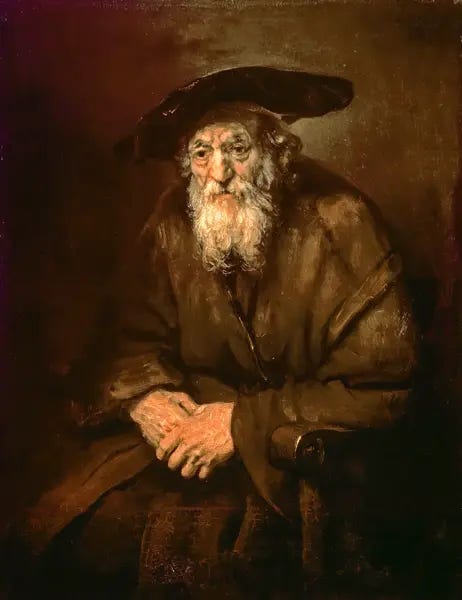
Rembrandt, Portrait of an Old Jew (1654)
It is my experience that traipsing through these historical shadows brings clarity to the shining light which the cantorate ought to represent and embody.
It is this chiaroscuro, the light-dark of the cantor’s history, which illuminates his spiritual mission from antiquity until today.
Beyond the Music is a reader-supported publication. To receive new posts and support my work, consider becoming a free or paid subscriber.
See Luigi Sisto, “Jewish and Converted Musicians and Musical Instrument Makers in Southern Italy in the Fifteenth through the Early Seventeenth Centuries,” Music and Jewish Culture in Early Modern Italy: New Perspectives (2022): 165-184.
I discovered this book in my doctoral research while surveying early modern ethical literature about cantors. It apparently was well-regarded in its time, identified as the principal source for a later publication, Azharot LeHazzanim (Ferrara, 1832) and was also published in a “Reader’s Digest” version. The first evidence I found of this was a reprint of Azharot LeHazzanim from a Yiddish cantorial journal reprinted by Akiva Zimmerman in his cantorial history book BeRon Yahad: From the World of the Cantorate and Jewish Music (Tel Aviv, 1988). Although his version claimed to be reporduced from a copy in the now-recovered Strashun library in Vilna, other copies have resurfaced, including these manuscripts of the book’s primary source, SeferShomrei Mikdash (HUC MS. 224(1), whose essential teachings were summarized in the Azharot.
This was just the right touch of humor, history, and heart to enjoy during Pesach. Thank you for bringing such light to the season — even while exploring its shadows.




This was just the right touch of humor, history, and heart to enjoy during Pesach. Thank you for bringing such light to the season — even while exploring its shadows.