
The Freemason's Aleinu
Brotherly Love, Relief, and Truth about an Old Melody


Over the past few months, I have been in hot pursuit of the unsung heroes behind our beloved synagogue melodies. This is in no small part because I have been working on a major article for publication entitled “Where the Tunes Come From: The Conservative Movement’s Musical DNA” which sources the musical genealogies of worship tunes from across the movement. There I focus on exposing a broad lineage of USCJ melodic influences, rather than digging down into the biographies of individual composers. Those deeper dives have been explored here at Beyond the Music, such as Birkat Hamazon, Ein Keloheinu, and HaMotzi.
Today, I am going to share with you the current state of research on perhaps the most ubiquitous of twentieth-century synagogue melodies: Aleinu.
And along the way, I’m going to introduce you to an obscure Jewish organist who played some very interesting gigs.
This opening melody of the aleinu is often attributed to famous figures like Cantor Salomon Sulzer and Rabbi Israel Goldfarb, and sometimes given that ultimate Jewish compliment of being labeled “traditional”.
Yet its clearest attribution is to a little-known musician named Sigmund Sabel (1849-1924).
I have been scouring the internet for information on this man. There have been many twists and turns along the way, and my current feelings about him can be summed up as follows:

That is to say: I have my theories, but I’m as close to finding the original source linking Sabel to aleinu than Charlie Day was to finding Pepe Silvia.
For your consideration, here’s my evidence board1:
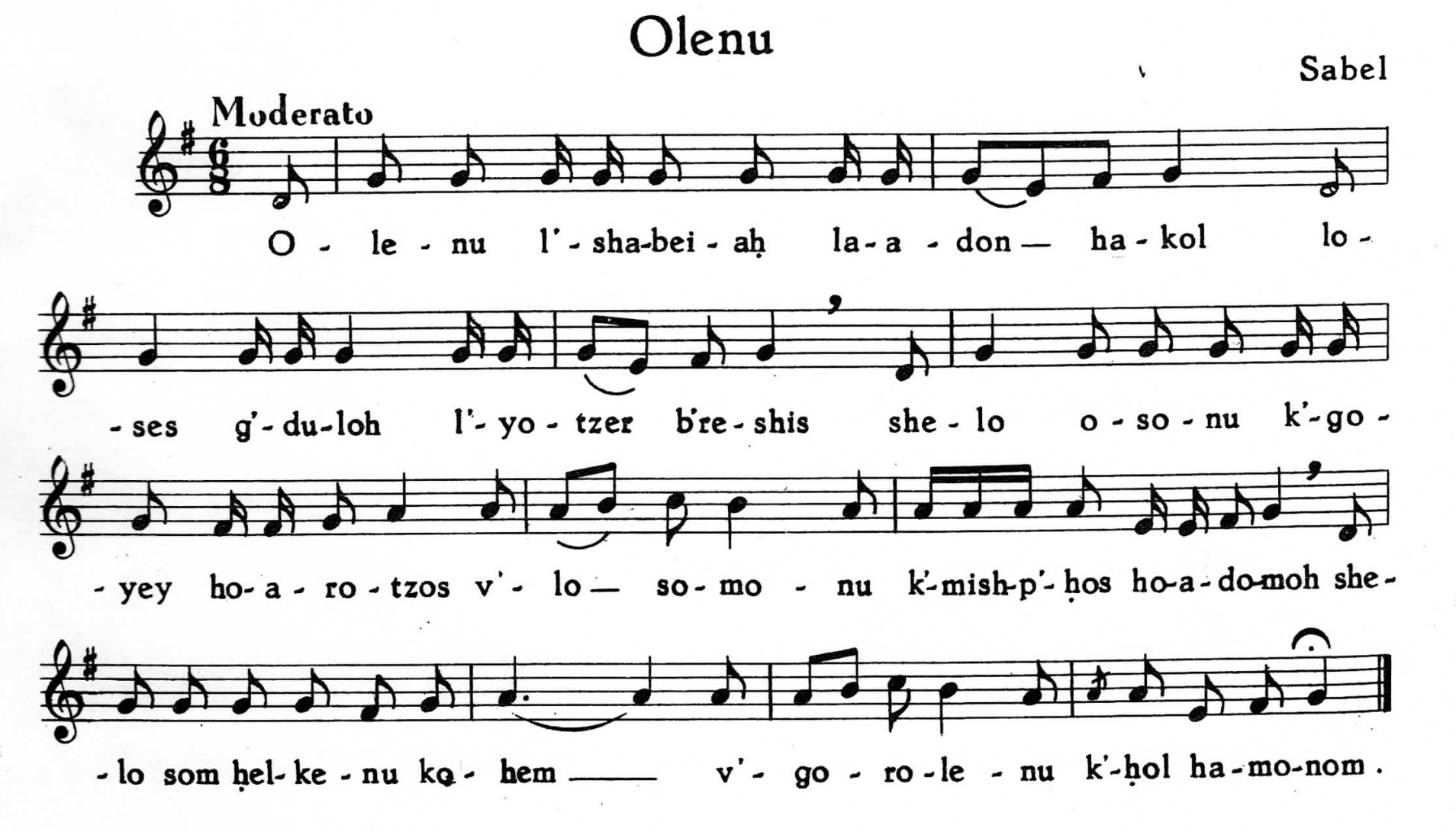
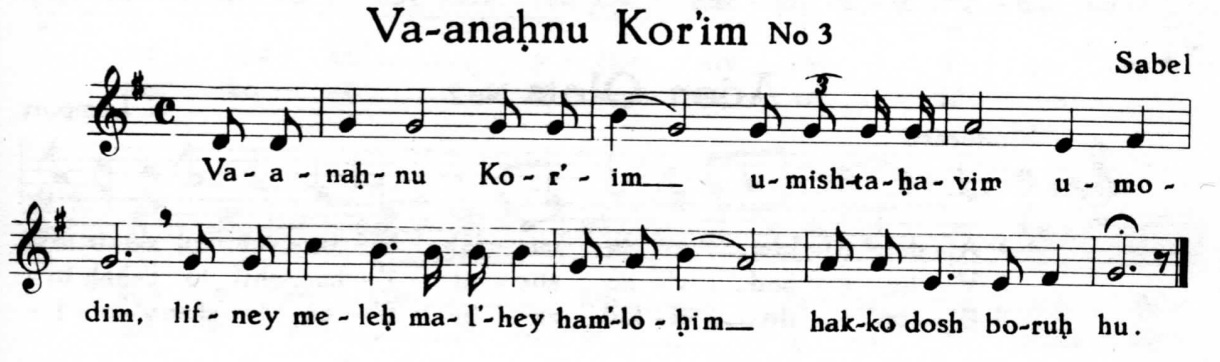
[UPDATE 7.14.26]: When I first published this article, I had been under the impression that the aleinu sung the world around was first notated in the Cantors Assembly’s first publication of congregational melodies, Zamru Lo (1955), edited by Moshe Nathanson, the longtime cantor of the Society for the Advancement of Judaism. Here, the composer is indicated as[Sigmund] Sabel, whose “Oleinu” and “Va-anaḥnu Kor’im” comprise the sum total of his published compositions in the book.
But due to the helpful observations of reader Kevin Longobart, I was reminded that Sabel’s melody was arranged earlier by Israel & Samuel Goldfarb in The Jewish Songster (1925):
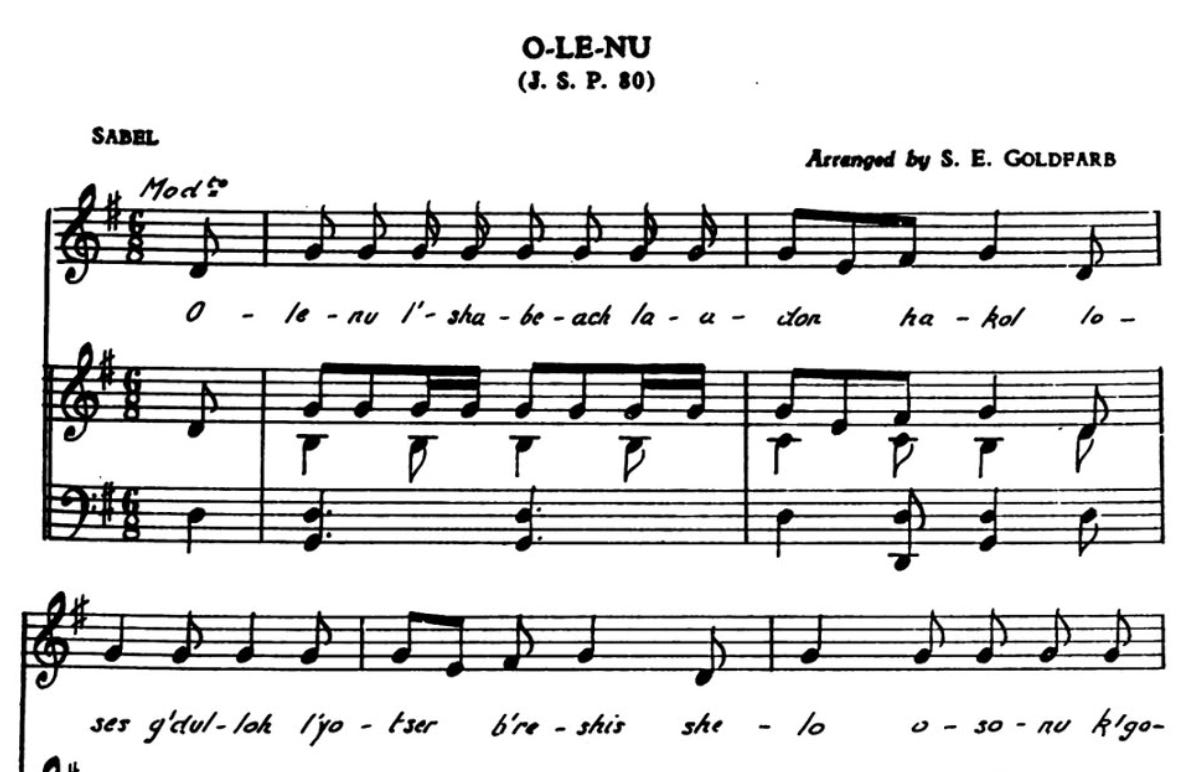
While Sabel is indicated as the composer of the first melody, the second appeared instead as “Traditional” in Israel Goldfarb’s Songs & Praise for Sabbath Eve (1920):
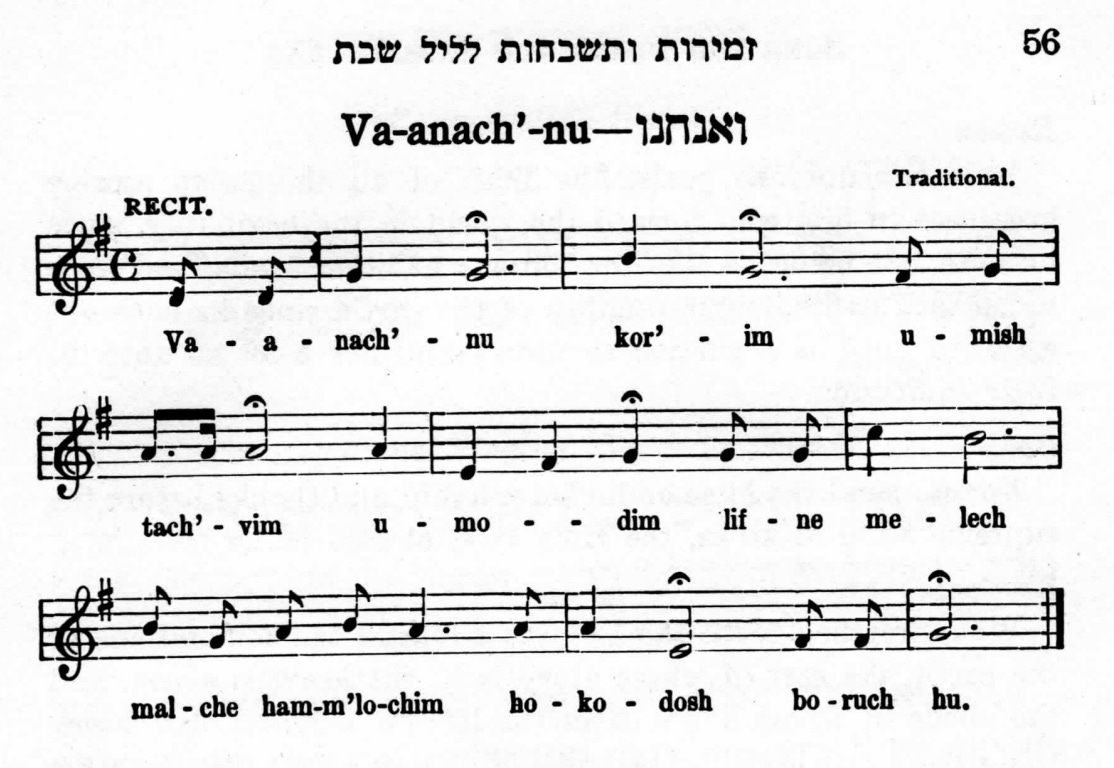
Such a designation may be due to forgetfulness of time, due to the melody’s popularity. The basic outline of this “Va-anach’-nu” also follows from one of Cantor Salomon Sulzer’s own aleinu compositions from mid-nineteenth century Vienna:
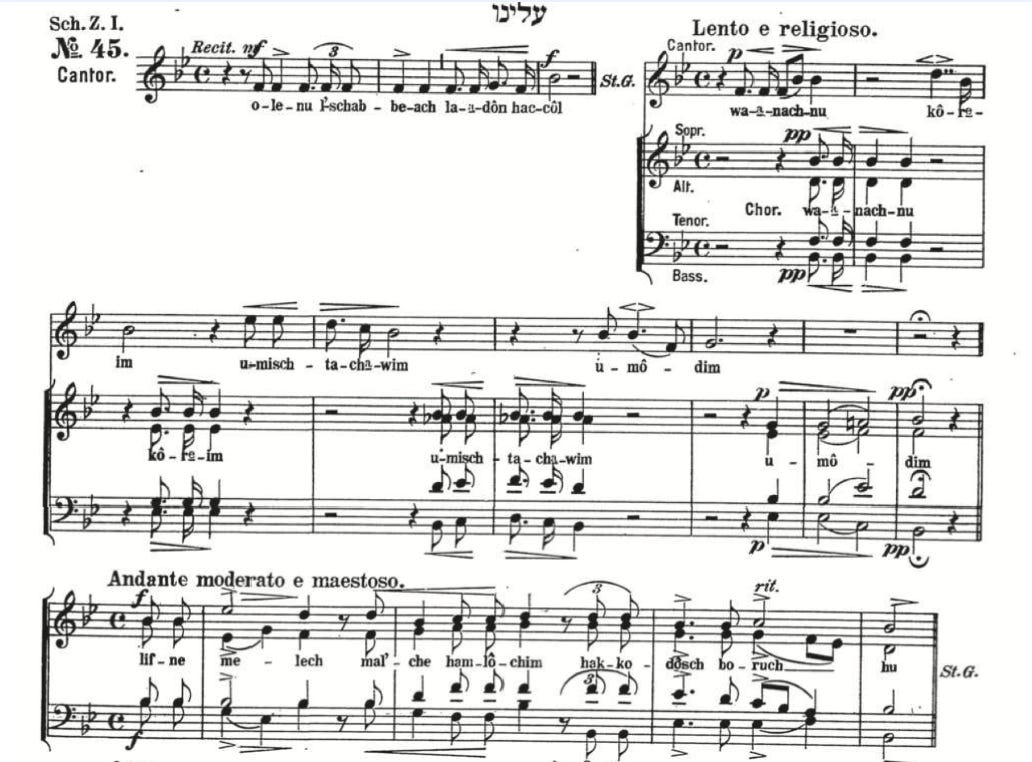
Did Sabel perhaps compose one part of the melodies but not the other, which he created by simplifying the Sulzer which he learned during his youth? And moreover — who was Sigmund Sabel and how did Nathanson and the Goldfarbs come to know of his work?
This essay is a first attempt to outline the biography of Sigmund Sabel, showing the pathways by which his liturgical hit aleinu, only published posthumously, reflected his dedicated career of musical and communal service.
Sigmund Sabel was born on Februrary 19, 1849 in Vienna, Austria. He took a ship from Hamburg on August 20, 1873 to New York, where he settled and soon after married Ms. Hermina Gottlieb, with whom he would have five children. His musical career was as an organist and music director who proffered his accompanying (and sometime compositional) services across many Jewish institutions in New York.
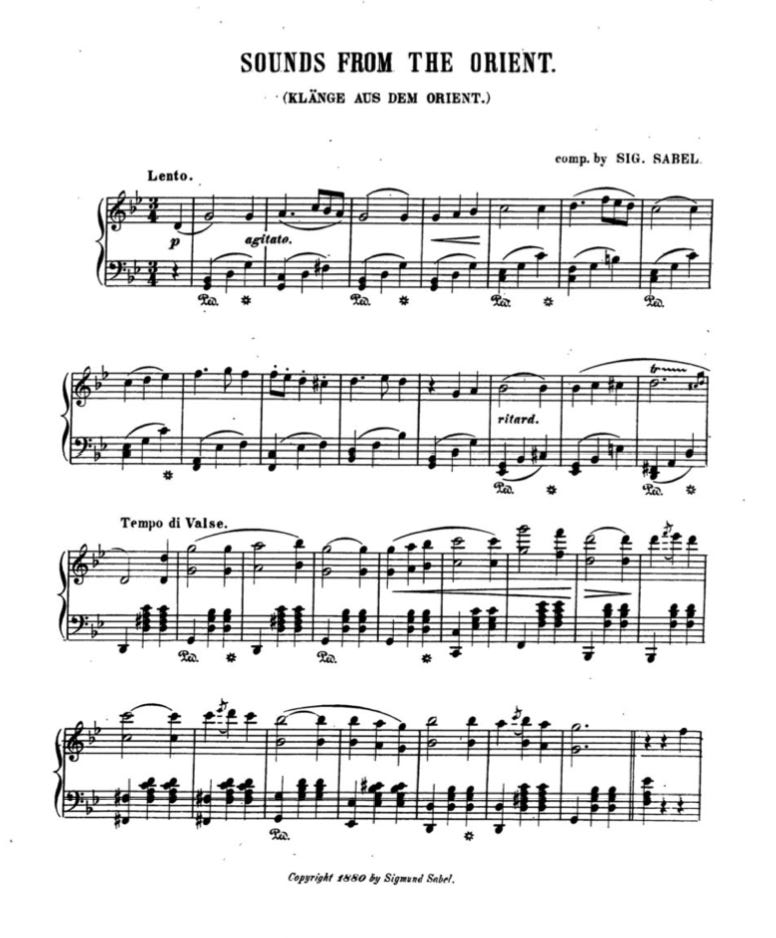
The earliest evidence of Sigmund Sabel’s musical output is his piano piece, “Sounds from the Orient (1880), published by Carl Fischer. Sabel perhaps made use of an “Oriental” Jewish aesthetic, although precise sonic signifiers to that effect are difficult to identify, other than its minor tonality.
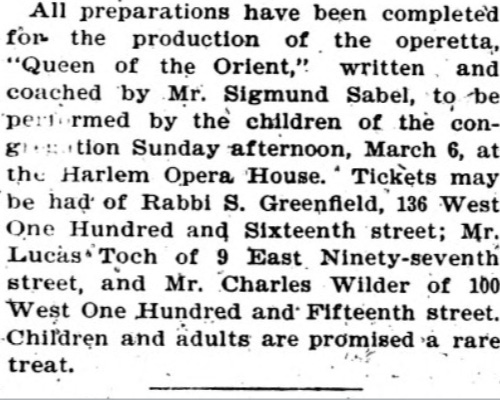
Sabel soon found gainful employment working in music education among disadvantaged youth, taking on the position of singing professor at the Hebrew Benevolent and Orphan Asylum Society from 1888 into the twentieth century. While serving as choir master and singing teacher, he also published two children’s operettas: Hadassah, or The Persian Queen (1891) and The Queen of the Orient (1894). Unfortunately, only the librettos were ever published; music needed to be obtained directly from the composer at his residence on 204 East 61st street. He found success staging these plays with youths at local synagogues, as with this performance with Mt. Zion Congregation at the Harlem Opera House in March of 1907:
Sabel’s musical activities continued to be felt in areas of public service. He long held the post of choir director of the Educational Alliance, which opened in 1889 as an early settlement house for Jewish immigrants.2 He served as the longtime organist for another settlement — the Social House of the Emanu-El Brotherhood—from 1902 through at least 1920.3 The Psalms proclaim that “the Lord preserves the stranger; he relieves the fatherless and widow.”4 This holy work appears at the heart of Sigmund Sabel’s long career in music.
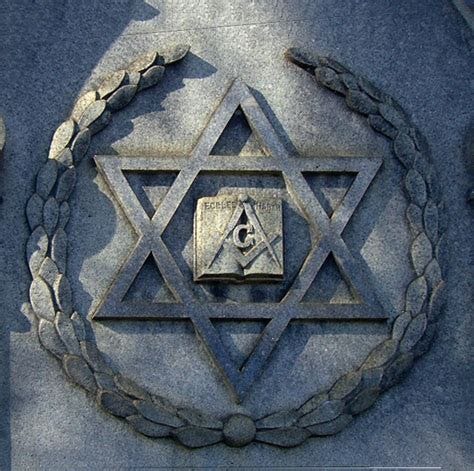
But it also relates to another part of Sabel’s social and humanitarian pursuits: freemasonry.
Here, we enter perhaps uncharted waters in Jewish musicology. Over the past many centuries, Jews across the world have found an affinity with the freemasons, whose society long offered them an ecumenical network of social connections and like-minded humanitarians.5 Masonic rites also required organists, and Sigmund Sabel was fit to the task. He served as an organist of no less than three masonic lodges — and as a member of more.
Upon his death in April 1924, five notices were taken out in the New York Times, including from Society B’nee Salem; Humboldt Lodge No. 512; King Solomon Lodge, No. 279 where he was “for many years a faithful organist;” and Perfect Ashlar Lodge, No. 604, where he was “esteemed organist for over thirty years.”
The unfortunately named German-language freemasonry journal, Der Führer, reported on the event of his passing:
“On Sunday, April 6, at the West End Funeral Chapel, W 91 St, a funeral service was held for the late Bro[ther] Sigmund Sabel, a member of Humboldt Lodge 512 for 43 years. The service was attended by a large number of distinguished members from Districts 8 and 9, many other lodges, and a large number of friends and acquaintances.”
The musical experience of American Jewish freemasons has not received any academic treatment, as far as I can tell. But perhaps it should be in future. Consider the famous cantorial tenor, Richard Tucker, who was a member of the same masonic lodge where Sigmund Sabel served as organist for three decades. I’m not saying that Jews were adopting masonic tunes or bringing their own repertoire into freemasonry. But it does make one wonder about the musical and ritual environment of the all-male masonic lodge, and how it shaped the culture of its many Jewish members.6
Sigmund Sabel was a hardworking Jewish organist for humanitarian institutions that represented the fundamental values of Judaism and freemasonry alike. The aleinu prayer attributed to him is one which asks God “l’taken olam b’malchut shaddai”— to repair the world with his reign. As an anthem of tikkun olam, it thus seems fitting that Sabel’s melody should still reign supreme.
When Moshe Nathanson came to the United States in 1922, Sigmund Sabel was still alive and in his autumn years. As one of the main galvanizing forces of Jewish music in New York (and beyond), it is possible for Nathanson to have received the aleinu melody when the composer’s identity was still known, if not from Sabel himself.
But where was it written? The Sabel aleinu certainly reflective of the style of the emerging Jewish hymnals of the early twentieth century— and, in no small part, of the style of the freemasons’ own ritual music. As a musician working with synagogues and children over many decades, especially through the generative years of American congregational singing, it is eminently plausible that Sabel tried his hand at liturgical music — even if he created only one enduring result.
Some of this is speculation, and I would be more than happy to have someone come to me with better evidence, one way or the other.
But for now, I am content to know that aleinu, which calls on us to praise the Creator of All, was composed by someone who truly believed in the brotherhood of humanity.
My sincere thanks to Cantor Sam Weiss for providing many of these references to the original aleinu melody sources.
An early children’s performance with the Educational Alliance shows Sabel as its musical accompanist, recorded in Werner’s Magazine in 1901:
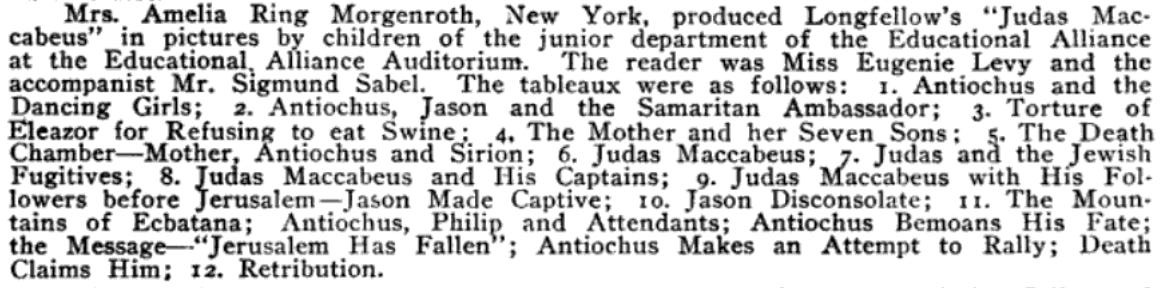
Another Educational Alliance appearance from 1912 can be found here: , as well as his participation in the center’s 25th anniversary in 1915.
cf. Emanuel-El Review 4, no. 1 (1918), 19; Charles M. Tremaine, New York’s First Music Week (New York: National Bureau for the Advancement of Music, 1920): 62.
Ps. 146:9.
For a fascinating early document of this affinity, see this eighteenth-century Jewish prayer at the opening of a masonic lodge.
I conducting an examination of the New Masonic Musical Manual (1897), from which Sabel would surely have played. I can say that it is a friendly mix of musical sources, including American folk song, European music, and patriotic hymn. But no overtly (or covertly) Jewish melodies.
D’var Acheir: Only knowing one Jewish freemason (a cantor, no less) prior to writing this essay, I was very pleased to be contacted by another colleague who himself had served as a masonic organist in England, and who reported a number of Jews still active in those societies.