
Yes, I Got You Presents
Eight Jewish Music Highlights for Hanukkah

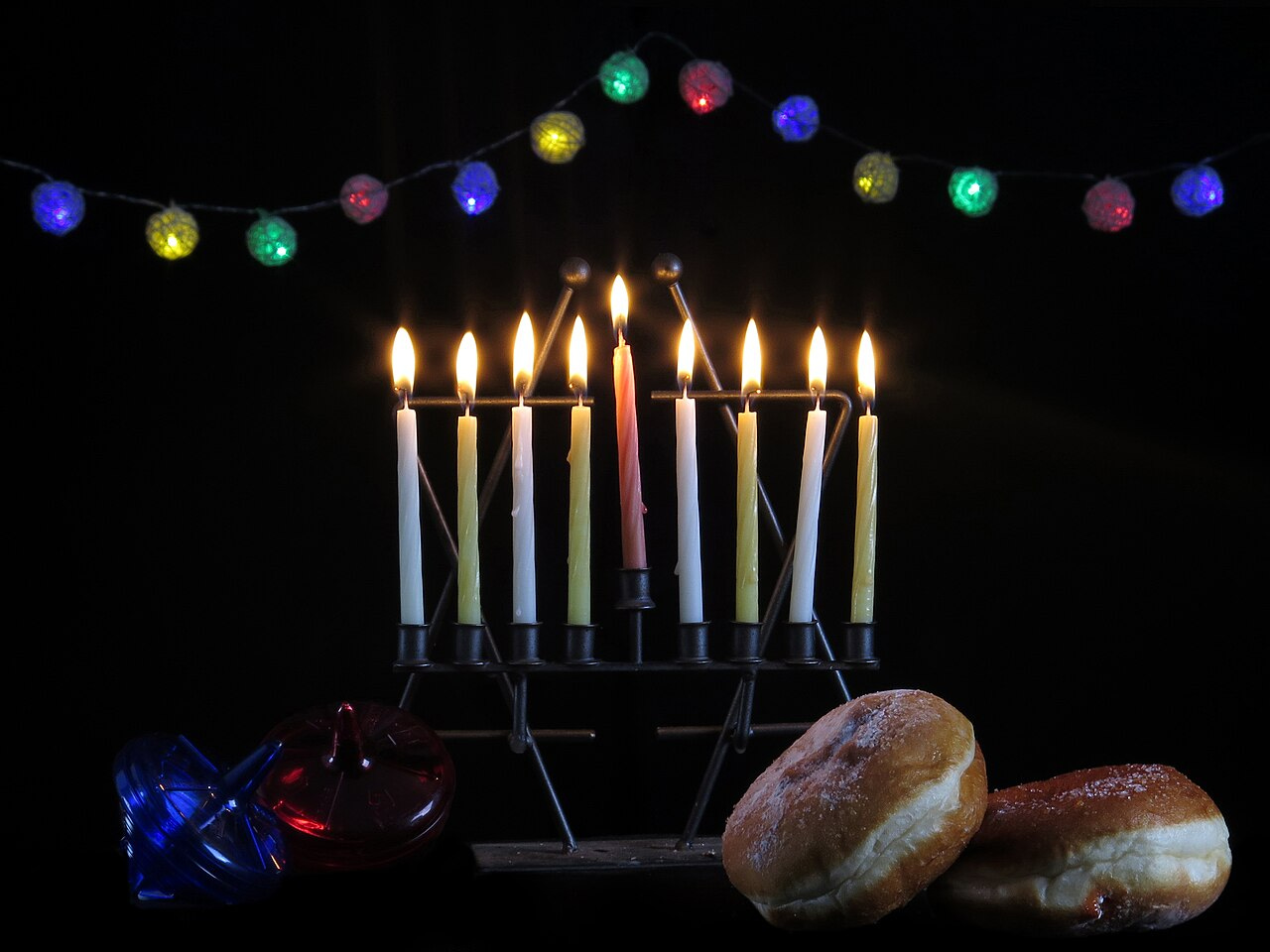
As the chanukiyah shines its light for the last time this year, Jewish children should give thanks — especially if they live in America, where we for the last century have largely taken on the custom of gift giving from our Christian neighbors. This is a far cry from the seventeenth-century practice of giving Hanukkah gelt, in which Jews distributed coins to teachers, and eventually to students as well. The origin of Hanukkah gelt in teacher appreciation should be no surprise, as the word hanukkah (“dedication”) has the same root as the Hebrew word hinukh (“education”).
The modern commercialization of Hanukkah, while unfortunately producing pop songs devoid of religious sentiment, also means that kids look forward to Hanukkah and its exciting candles, treats, and presents.
And so in the spirit of American Hanukkah, here are eight musical presents for you to unwrap:
1. Bei Mir Bist Du Podcast: The Jewish Song Show
If you told me last year that someone would create a Jewish music podcast with great storytelling and professional acting like an old-time radio play, I would have said: “It’ll never happen! Who has the knowledge, time, and chutzpah to put together something like that?”
The answer: Dr. Steve Singer does.
His new podcast, The Jewish Song Show, goes where no Jewish podcast has gone before — and nails it.
With spunky narration and humor likened to NatGeo’s hit edu-tainment podcast, Greeking Out, the pilot episode takes us through the early life of “Bei Mir Bist Du Shein” composer Sholom Secunda — from a nearly-drowned nebbish in Nicholayev to a star child cantor singing the High Holidays at Yiddish theater, on to being bowled over by Enrico Caruso, studying with Ernst Bloch, and more.
I didn’t know half of these anecdotes prior to listening, and now I feel like I understand Secunda in a whole new way.
The production is aided by excellent sound design from Christopher Lang and the comic ghost of Secunda voiced by Ed Kelly. Future episodes promise more juicy Secunda history, including strange tales of his famous hit song, Bei Mir Bist Du Shein. Singer knows his sources well, and also worked directly with the Secunda family to produce his show.
The Jewish Song Show is on Spotify, YouTube, and Apple Podcasts, and I can’t wait for the next episode to drop as a belated Hanukkah present.
2. The Return of the Immortal Khazntes
Chazonus is often depicted as a perennially “male” genre requiring whole-cloth adaptation to the female voice. Yet this erases the hundred-year history of Ashkenazic female cantors and vocalists who have successfully commanded the style. The first generation of these were the khazntes of the 1920s-1970s who came to prominence in the era of Vaudeville and Yiddish radio. And thanks to Jeremiah Lockwood — they are back for a new generation.
As our era’s new impresario of old-style cantorial revival, Lockwood has brought together the amazing modern khazante voices of Riki Rose, Judith Berkson, Rachel Weston, and Shahanna Mckinney-Baldon for The Return of the Immortal Khazntes, the third album from his label and nonprofit arts organization, Khazones Underground.
An album like this digs deep wells for revived cantorial aesthetics, asks questions of the future of cantorial arts, and drips with emotion and authentic Ashkenazic fervor. Listen and purchase on Bandcamp this Hanukkah and give yourself the gift of “The Immortal Khazntes.”
3. Cancelling the Holidays by Cantor Dan Singer
If you can’t tell, BDS and antisemitism are not only bad for the economy, they’re bad for the music business (Eurovision is a case-in-point).
For a hilarious and scathing send-up of this social pathogen, enjoy Dan Singer’s “Cancelling the Holidays.” This seasonal parody runs through all of the hit Christmas songs by Jewish composers, and takes additional aim at the antizionists seeking to stigmatize public Judaism.
Remember: No Maccabees, No Jews, No Christmas (or Ramadan for that matter).
4. Khanike, lomir tseyln (“Hanukkah, let’s count”) by Cantor Sarah Myerson
Counting songs are among the oldest of Jewish folk songs, from Passover’s Echad Mi Yode’a to Flory Jagoda’s modern Ocho Kandelikas. Cantor Sarah Myerson’s original Yiddish counting song, “Khanike, lomir tseyln,” slips right into this musical and mathematical tradition, with clever lyrics and spot-on style.
After learning this song, not only will your Yiddish be better, but you’ll be able to remember all sorts of useful facts about Hanukkah!
5. Maoz Tzur (Marcello) arranged by Hugo Chaim Adler
Every Hanukkah, I sing songs all around the community, mostly in unison with my audience. But I must admit, I sometimes miss the sweet wintry harmonies of Christmas carols which I sang as part of my chamber choir days in Colonial Williamsburg.
I recently came across the above arrangement of the old Ashkenazic Maoz Tzur, as notated by Benedetto Marcello in 1724 but harmonized almost like a Christmas carol. Cantor Hugo Chaim Adler was a Holocaust survivor and longtime cantor in Worcester, MA (and also father of the well-known American composer, Samuel Adler); his majestic arrangement, beautifully shaped by Mati Lazar and the Zamir Chorale, took me back to my caroling days, and would be fitting on any “Winter Concert” program.
6. Hanuká by Sarah Aroeste
“Ocho Kandelikas” by Flory Jagoda is usually the token Judeo-Spanish number on Hanukkah programs — another counting song that easily charms American-Jewish ears. Sephardic songstress Sarah Aroeste has been long trying to expand American musical palettes to include more diverse music of the Sephardic and MENA communities. With lyrics by Turkish-Jewish poet Lina Cohen Albukrek (1898-1988) and melody by Ladino singer Judy Frankel (1943-2008), Aroeste’s Hanuká offers a singable, upbeat bop and an entree to a whole world of Sephardic Hanukkah music.
7. Mizmor Shir Chanukas Habayis LeDavid (Viznitz) by Hazmana LePiyyut (Invitation to Piyyut)
This is an old video. But it is one that has stayed with me for two reasons:
(1) it showcases the sophisticated, multi-part structure of many hasidic melodies, particularly among the Viznitz hasidim; and—
(2) it demonstrates the sheer joy of singing piyutim. From gentle bouncing to charming harmonies to flashes of smile and enthusiasm, one feels this ensemble’s musical journey as not only one of spirituality but of personality as well.
8. Hanukkah by Sholom Secunda; solo, Jacob Barkin
With Sholom Secunda getting the first word, I thought I’d give him the last one as well.
This English number comes from the album “Sholom Secunda’s Family Chanukah Festival (1964)” conducted by the composer and starring the stentorian wonder-tenor, Cantor Jack Barkin (he was offered a contract at the Metropolitan Opera, and you can hear exactly why). While a little cheesy, it’s an endearing proclamation of American-Jewish religiosity in the mid-twentieth century.
There. I hope I haven’t spoiled you too much.
Please enjoy these musical presents, and may we keep the full-light of the chanukiyah burning in our hearts until next year.
Wishing you and Elyssa a Happy Hanukkah, Matt!
Love the Marcello version and wish it was sung more often ' not to "replace" the traditional Ashkenazi version but in addition to it.