
The Exodus from Ancient Egyptian Music
Reality over ritual, people over culture, and ethics over aesthetics

.jpg)
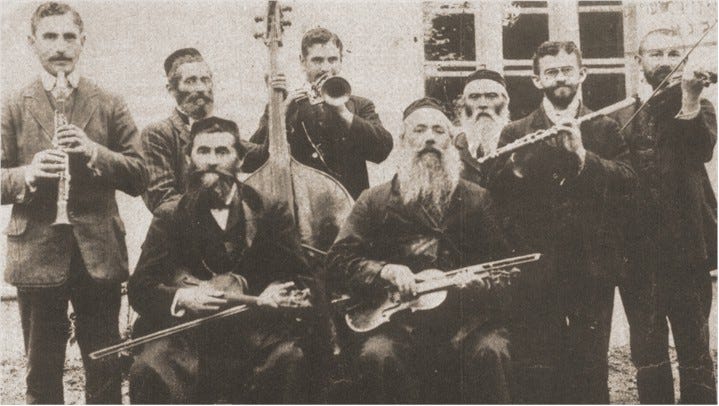
I have a saying about Jewish music: “it’s process, not product.”
This may sound like a pretentious phrase applied by writers, self-help gurus, theologians, and even entire Jewish denominations to avoid static or unattainable perfections and focus instead on nurturing practices.
But when it comes to Jewish music, the aphorism is both spiritually uplifting and empirically true. While early Jewish musicologists like A.Z. Idelsohn attempted to render Jewish music as possessing essential “national” characteristics, the recurrent history of Jewish music is one of adapting broadly-sourced musical materials. Ashkenazi Jewish music is littered with European street songs, hymns, dance tunes, opera, and even snatches of Ottoman maqam — all appropriated, deconstructed, and transformed for particularistic Jewish purposes. While some Jewish music falls in to the Curt Sachs definition of “music by Jews, for Jews, as Jews,” the majority of our musical history is one of transformational processes rather than static musical products.
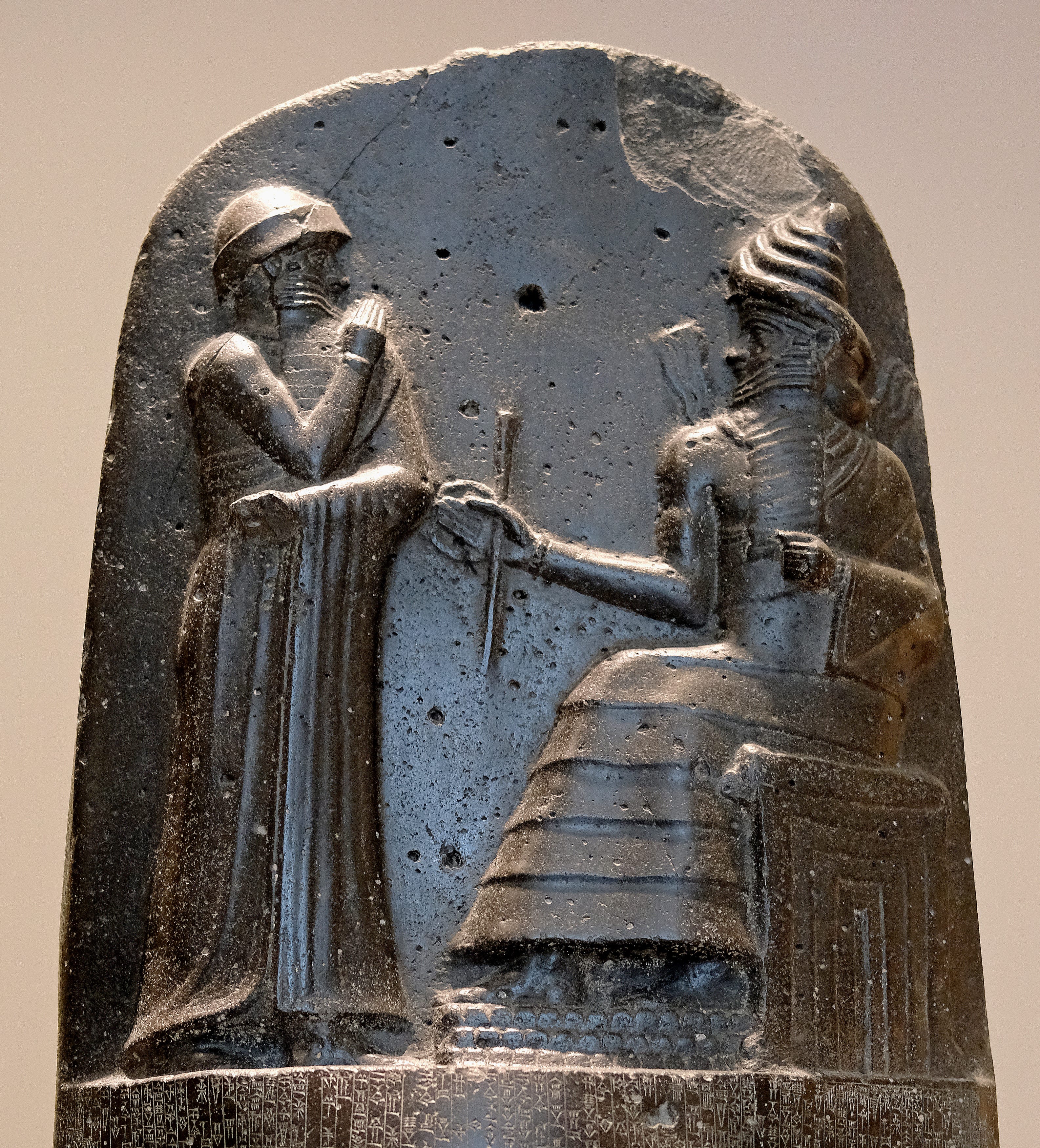
One could make this argument about much in Jewish culture — even parts of the Torah itself. The famous legal formulation of “an eye for an eye” (Exod. 21), later reinterpreted by rabbinic Judasim, is illuminated at its core by parallels with the widely-promulgated Code of Hammurabi (c. 1753 BCE). The Israelite version, unlike its Mesopotamian counterpart, does not distinguish punishments based on social class because all lives, according to Torah, are equally in the image of God.1 What comprises Torah, in this case, is the transformation of legal raw materials in the crucible of Jewish religious principle.
To traditional believers, this may sound like heresy. But as Rabbi Dr. Joshua Berman of Bar-Ilan University points out, this comparative approach dates back to one of Judaism’s greatest rabbinic minds — Maimonides (1135-1204):
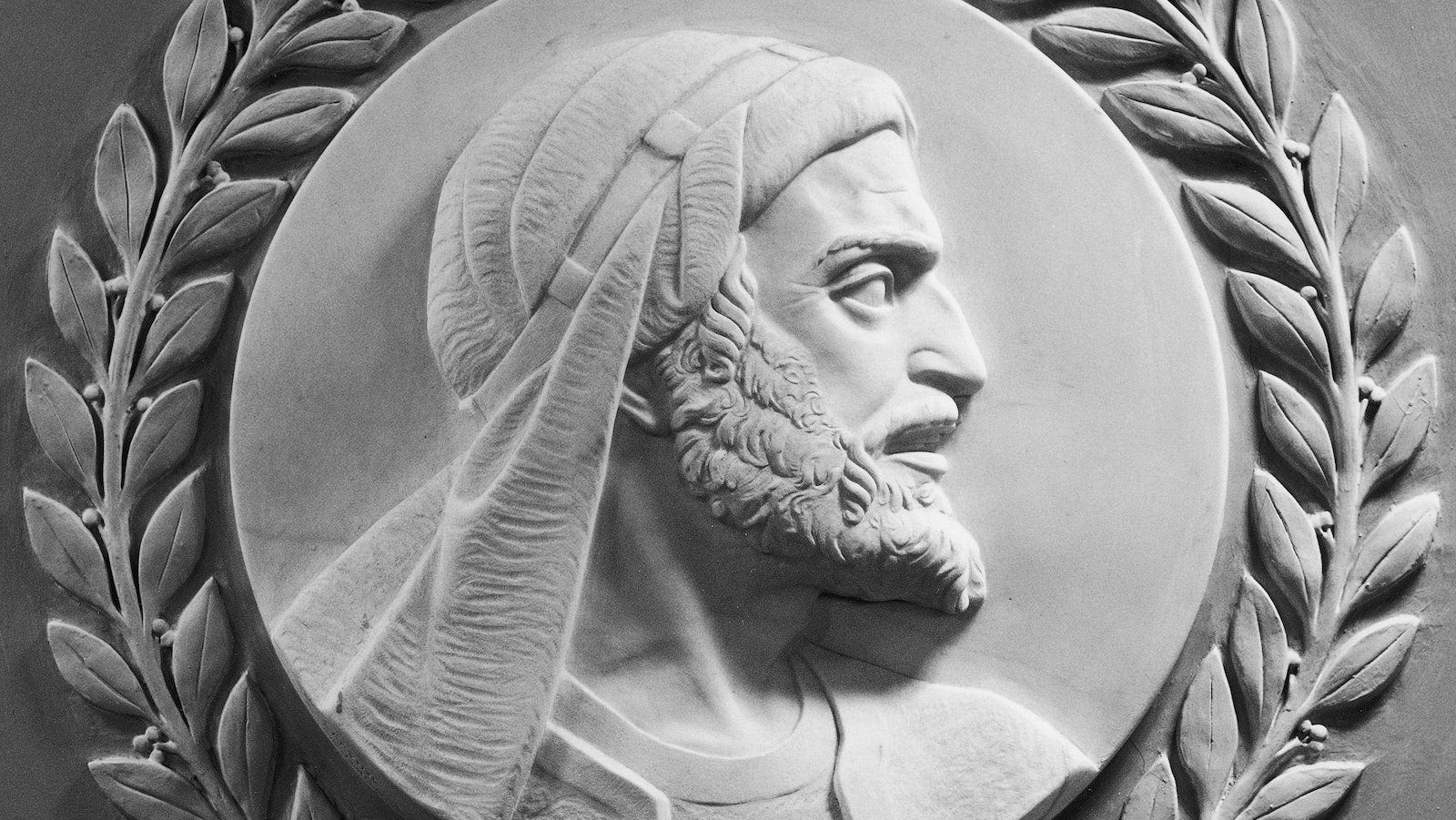
“In order to understand Scripture properly, Maimonides writes, he procured every work on ancient civilizations known in his time. In his Guide of the Perplexed, he puts the resultant knowledge to service in elucidating the rationale behind many of the Torah’s cultic laws and practices, reasoning that they were adaptations of ancient pagan customs, but tweaked in conformity with an anti-pagan theology...At the end of the Guide, Maimonides states that his insight into the topic would have been much greater had he been able to discover even more such sources.”
This approach to Torah, however rationalistic or dependent, feels to me no less divine. It helps sense the palpable divine inspiration and subsequent ethical impulses that flowed through our ancestors — a divine voice which is still accessible to us today. So too, Jewish music is built from the raw musical materials of the world, yet bounded in holiness through sonic adapations which serve its particularistic religious and national purposes. Jewish music, in this way, is not a mummification of old forms, but like Jewish law, lives and breathes with the mission of the Jewish people.
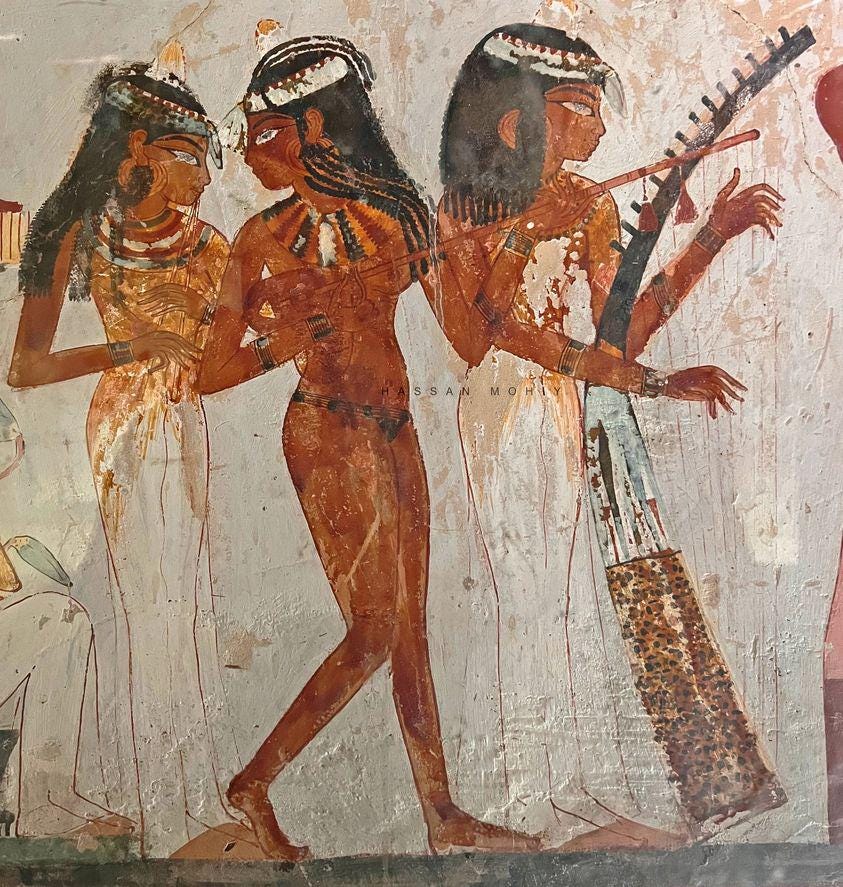
The Passover seder demands: “In every generation, a person is obligated to see himself as if he personally went out of Egypt.”
This year, I asked myself: What does this mean for Jewish music?
The Ancient Egyptians were masters of music. Theirs was a society rich in spectacle, ritual, and symbol which dramatized the worship of the gods and the cult of kingship. It was a culture in which the “real” and the “ritual” were rarely differentiated. From working the fields to military marches, priestly hymns to public parades, and courtly adorations to erotic encounters that would make even HBO blush, Egyptian music, like its art, enveloped society within its cosmic order— the symbolic symphony of Pharaonic divinity.2 Plato records that this aesthetic order was so important that the musicians eventually embalmed the music itself:
“It appears that long ago [the Egyptians] determined on the rule…that the youth of a State should practice in their rehearsals postures and tunes that are good. These they prescribed in detail and posted up in the temples, and outside this official list was, and still is, forbidden to painters and all other producers of postures and representations to introduce any innovation or invention, whether in such productions or in any other branch of music, over and above the tradtional forms…As regards music, it has proved possible for the tunes which possess a natural correctness to be enacted by law and permanently consecrated.” (Plato, Laws, 656-7)3
What does it mean to musically go out from this world — from its rich and highly symbolic culture emphasizing order, kingship, eros, and afterlife? How can one make Jewish music after four hundred years of imbibing these totemic tones?
It is perhaps no wonder that the Torah, from its very inception, was largely skeptical of music. Knowledgeable of music’s power across human endeavors, it nevertheless portrayed the first musician as coming from a genealogy of violent and degenerate technocrats — not unlike what the Israelites would have observed among their imperial neighbors.
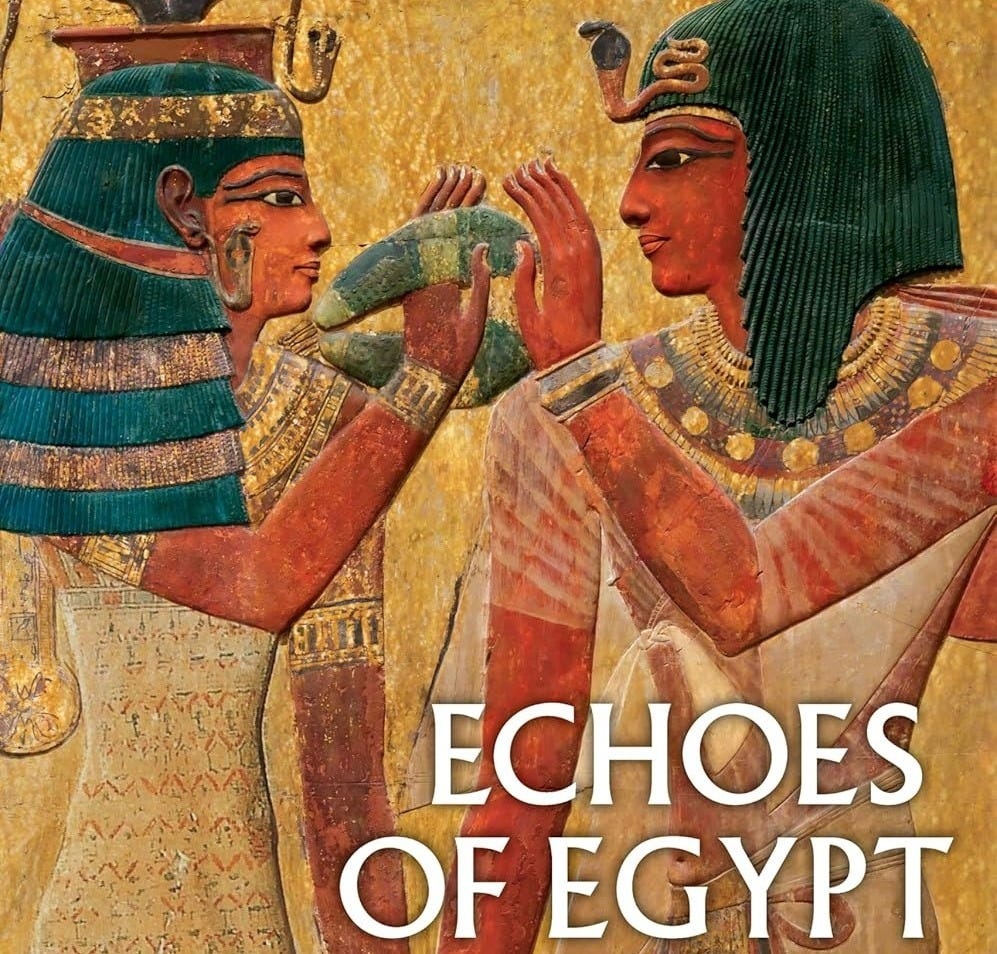
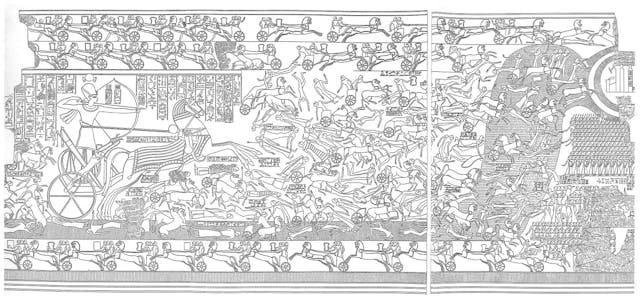
This year, I’m again inspired by the work of Rabbi Berman, who just came out with a new haggadah, Echoes of Egypt, based on his longterm comparative study of Egyptian and Israelite cultures. Rabbi Berman’s ongoing research demonstrates how ancient Israelites actively borrowed from Egyptian depictions of Pharaonic power: borrowing the phrase “a mighty hand and an outstretched arm” from Ramesside propaganda, basing the tabernacle on Pharaoh’s military tent, and using the highly-publicized story of the Battle of Kadesh (1274 BCE) as the linguistic foundation of God’s miracle at the Sea of Reeds.4
In place of the Pharaoh and the gods, the musical focus of ancient Israel naturally became the worship of God in his tabernacle. But there remains one essential difference — the complete non-magical nature of Israelite musical activity. As I’ve argued elsewhere, the Hebrew Bible constantly subverts human attempts at theurgy and magic, many of which have musical overtones. By desacralizing the practice of music and its role in sustaining the cosmic order, the Torah transforms music into a humanistic practice, embarassing the symbolic solipsism of Egyptian king worship and relocating musical power to the interpersonal realm.
This amplifies Rabbi Berman’s recent observation on the Tikvah Podcast that Israelite society believing in the worth and eternity of its people over the surety of an individual afterlife:
“The Egyptians were very into the afterlife. King Tut’s tomb had 5,800 artifacts in it. Their belief in the afterlife was like our belief in tomorrow – we don’t know for sure tomorrow is coming, but we sure do act like it. But in the Hebrew Bible, mortality is overcome — [not because of the heavenly eternity of the individual, but] by celebrating the eternal relationship between God and the people of Israel in covenant.”
With the people as the secret to eternity, biblical music will be exercised and judged as a function of its support of people and their relationship to God and his law. The ubiquitious percussion traditions of Ancient Near Eastern women will be vacated of magic and prostitution, offering Miriam and Israelite women non-magical roles as communal musicians and party leaders. Music will be invoked in healing and even supporting mental illness (cf. 1 Sam. 16:23), but the source of such healing will be the Lord alone. Like all forms of generative human expression, music will be channelled into positive purposes — not as the source of magical power and cosmic ritual but as the natural outpouring of the humble, human soul.
The Israelites may have brought with them the power of Egypt’s music, but they left (or attempted to leave) the Egyptian symbolic regimen that set ritual over reality, culture over people, and aesthetics over ethics. 5
It is this process — this leaving of Egypt— that we must revisit in every generation.
Chag Sameach.
This is also true in the case of the shor mu’ad (the goring ox), in which the Torah demands the death of the goring ox for killing a human being. The Code of Hammurabi does not consider the ox liable, and only assigns minimal fines in the case of child or slave death. For more, see David Wright, “How Exodus Revises the Laws of Hammurabi” (Thetorah.com).
The symbolic intensity of Egyptian culture here reminds me of an aphorism from Eric Hoffer: “If we want people to behave in a certain manner, we much set the stage and give them a cue. This is true also when it’s ourselves we want to induce. There is no telling how deeply a mind may be affected by the deliberate staging of gestures, acts, and symbols. Pretense is often indispensable step in the attainment of genuineness. It is a form into which genuine inclinations flow and solidify.” —The Passionate State of Mind, 1956, p11t2.
Quoted in Lise Manniche, Music and Musicians in Ancient Egypt (1991), 9.
Rabbi Bermans’s seminal article, “Was There an Exodus,” can be found here with responses from other scholars: https://ideas.tikvah.org/mosaic/essays/was-there-an-exodus.
This Israelite innovation represents the first of two major correctives of Western civilization to the practice of music — the Israelite ethical corrective (as exemplified by the Hebrew Bible), and the Greek harmonic corrective (as exemplified by Pythagoras and the evolution of tonality and music notation). Both circumscribed musical practice for the sake of order — the ethical and the natural. The generative power and ultimate limit of these correctives in shaping Western music and civilization will be the subject of a future post.
Subtly beautiful, deeply perceptive, and very inspirational.